
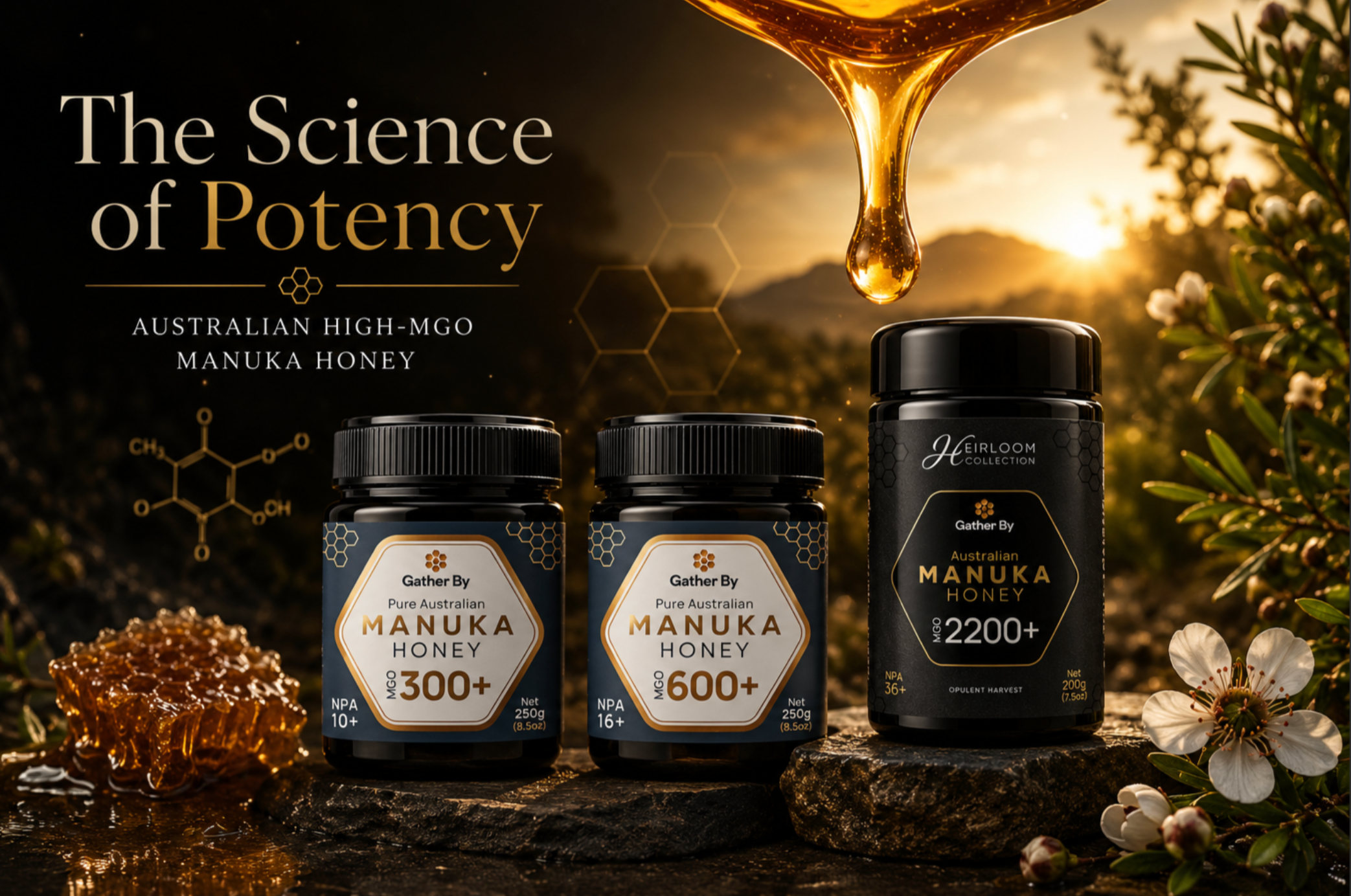
Why High-MGO Manuka Honey Is Different: The Science of Potency and Bioactivity
Educational pillar content explaining MGO levels and premium positioning.
Not all Manuka honey is the same.
To many people, honey is simply a natural sweetener — something enjoyed in tea, on toast or as part of a wellness routine.
But genuine high-MGO Manuka honey is very different.
Behind every jar sits a remarkable combination of:
-
Australian native plants
-
Bee behaviour
-
Climate
-
Time
-
Chemistry
-
Scientific testing
And at the centre of it all is one important measurement:
MGO
At Gather By, one of the most common questions we hear is:
“What does MGO actually mean — and why are some Manuka honeys so much more potent than others?”
The answer is part science, part nature, and part rarity.
What is MGO?
MGO stands for methylglyoxal — a naturally occurring compound associated with the unique antibacterial and bioactive properties that distinguish Manuka honey from conventional honey.
The higher the MGO rating, the higher the measured concentration of methylglyoxal present within the honey.
For example:
|
MGO Rating |
General Potency |
|
MGO100+ |
Mild activity |
|
MGO300+ |
Everyday wellness support |
|
MGO600+ |
Higher potency |
|
MGO900+ |
Premium high-strength Manuka |
|
MGO2200+ |
Extremely rare ultra-premium potency |
Unlike ordinary honey, Manuka honey can therefore be scientifically measured for its activity.
This is one reason it has attracted growing global attention from researchers, healthcare professionals and consumers seeking premium natural wellness products.
Why Manuka honey is different
Most honey contains naturally occurring peroxide activity.
Manuka honey is different because it also contains measurable non-peroxide bioactivity associated with methylglyoxal (MGO).
Research into Manuka honey continues to explore its potential role in areas such as:
-
Antibacterial activity
-
Inflammation response
-
Wound care environments
-
Skin health
-
Oral health
-
Gut health
-
Immune support
Medical-grade Manuka honey has also been studied in hospitals and clinical settings due to its measurable antibacterial properties.
Importantly, Manuka honey should not be viewed as a replacement for professional medical care — but it is increasingly recognised as one of the world’s most biologically active honeys.
How MGO forms naturally
One of the most fascinating things about Manuka honey is that bees do not directly produce MGO.
Instead, bees collect nectar containing a naturally occurring compound called DHA (dihydroxyacetone) from specific Leptospermum plants — commonly known as Manuka.
Over time, the DHA naturally converts into methylglyoxal inside the honey.
This transformation process is unique.
And it’s one of the reasons producing high-MGO honey is so difficult.
Everything matters:
-
Plant genetics
-
Nectar quality
-
Bee health
-
Climate conditions
-
Seasonal rainfall
-
Flowering intensity
-
Honey maturation time
Even then, nature offers no guarantees.
How bees and time help create high-MGO honey
One of the most remarkable things about high-MGO Manuka honey is that its potency develops naturally over time.
When bees collect nectar from high-DHA Leptospermum plants, the nectar is temporarily stored within the bee’s separate nectar stomach — sometimes referred to as the honey stomach — before being returned to the hive.
During this process, bees introduce natural enzymes that help transform the nectar into honey.
At harvest, freshly produced Manuka honey often contains relatively high DHA levels and comparatively lower MGO levels.
Over time, however, a natural bioactive maturation process begins.
As the honey is stored under controlled conditions, the DHA slowly converts into methylglyoxal (MGO) — increasing the honey’s measurable bioactivity over months and, in some cases, years.
This is one reason genuine high-MGO Manuka honey is so highly valued.
It cannot simply be manufactured or rushed.
It evolves naturally through the relationship between plant chemistry, bees, time and careful storage.
In some premium honeys, this maturation process may continue over an 18-month timeline as DHA levels gradually decline and MGO levels increase.
Nature effectively completes the process.
When is Manuka honey ready?
Because Manuka honey continues evolving naturally over time, timing matters.
As DHA gradually converts into methylglyoxal (MGO), the relationship between the two compounds changes throughout maturation.
At Gather By, honey is carefully monitored and independently tested throughout this process.
Once the honey reaches an optimal balance of DHA and MGO — often around a 2:1 MGO-to-DHA ratio depending on the batch — it is prepared for release.
At this stage, the honey is:
-
Independently tested
-
Registered and batch tracked
-
Fully traceable to origin
-
Carefully hand packed
-
Labelled with certified MGO activity
This process helps ensure the honey is released in peak condition for quality, potency and freshness.
Every jar is supported by provenance systems designed to provide transparency and confidence from hive to home.
Australia’s unique advantage
Australia is home to more than 80 native Leptospermum species — significantly more than anywhere else in the world.
Many of these species naturally produce high DHA nectar, which is critical for developing premium high-MGO honey.
Importantly, not all Leptospermum species behave the same way.
Some Australian varieties have demonstrated exceptionally high DHA potential under the right environmental and climatic conditions.
Australian high-DHA Leptospermum species continue attracting increasing scientific and commercial interest globally.
Species attracting increasing scientific and commercial interest include:
-
Leptospermum polygalifolium
-
Leptospermum liversidgei
-
Leptospermum whitei
-
Leptospermum brachyandrum
-
Leptospermum speciosum
-
Leptospermum scoparium
Leptospermum scoparium is the species most commonly associated with New Zealand Manuka honey and is also naturally present within Australia.
It is generally considered a cooler-climate Leptospermum species and, under many conditions, has demonstrated lower DHA levels compared with some Australian northern and subtropical varieties.
Australia’s broader Leptospermum diversity continues attracting increasing scientific interest for its high-DHA nectar potential and resulting MGO activity.
Research and field observations continue to explore how genetics, climate, flowering intensity and soil conditions influence nectar chemistry and resulting bioactivity.
At Gather By, much of our work has focused on identifying and propagating high-DHA Australian genetics capable of producing premium high-MGO honey.
This includes:
-
Medicinal Honey Forest™ plantings
-
High-DHA varietal selection
-
Bee-supporting ecosystems
-
Provenance and traceability systems
across the east coast of Australia.
Why high-MGO honey is rare
High-MGO honey is not simply “stronger honey.”
It is significantly rarer.
Very high MGO levels occur only when multiple natural conditions align correctly.
This includes:
-
High-DHA nectar flow
-
Healthy bee populations
-
Strong flowering events
-
Suitable climate conditions
-
Proper maturation time
In many seasons, exceptionally high-MGO honey represents only a very small percentage of total harvest volumes.
This is why genuine:
-
MGO900+
-
MGO1200+
-
MGO2200+
honeys are produced in limited quantities globally.
At these levels, Manuka honey becomes less like a commodity — and more like a rare agricultural product shaped by nature itself.
Understanding MGO, UMF™ and Total Activity (TA)
Consumers are increasingly seeing different grading systems used across premium Manuka and bioactive honeys.
These may include:
-
MGO (Methylglyoxal)
-
UMF™ (Unique Manuka Factor)
-
TA (Total Activity)
While all attempt to describe biological activity, they are not identical systems.
MGO
MGO measures the concentration of methylglyoxal present in the honey through direct laboratory analysis.
Because MGO can be quantified in milligrams per kilogram (mg/kg), it has become one of the most widely recognised potency indicators used globally in Manuka honey.
UMF™
UMF™ (Unique Manuka Factor) is a New Zealand trademarked grading system that measures broader Non-Peroxide Activity (NPA) alongside additional marker compounds associated with authenticity and activity.
MGO is one component used within the UMF™ framework.
TA (Total Activity)
TA refers to Total Activity and measures broader antibacterial activity, including hydrogen peroxide activity.
Because peroxide-based activity can fluctuate more significantly depending on factors such as storage conditions, heat and time, TA measurements may fluctuate more significantly over time compared with direct MGO measurement.
This is one reason why MGO has become one of the most widely recognised and scientifically measurable markers used in premium Manuka honey globally.
The role of phenolics and Australian research
Beyond MGO, researchers are increasingly interested in the broader chemical complexity of Manuka honey.
This includes naturally occurring compounds known as phenolics — plant-derived compounds associated with antioxidant activity and biological complexity.
Research involving the Australian Manuka Honey Association (AMHA) and the University of the Sunshine Coast (USC) has identified additional marker compounds present within Australian Manuka honey, helping build a deeper understanding of its unique bioactive profile.
This research continues to explore how:
-
Plant species
-
Floral source
-
Climate
-
Geography
-
Flowering conditions
influence the chemistry and biological activity of Australian Manuka honey.
At Gather By, our honey is independently tested for:
-
MGO
-
DHA
-
HMF (Hydroxymethylfurfural)
-
Authenticity and provenance markers
to help ensure quality, freshness and traceability throughout the maturation process.
Testing is conducted using accredited laboratory methodologies.
MGO300+ vs MGO600+ vs MGO2200+ — choosing the right potency
Different people choose different strengths depending on preference and routine.
|
MGO Level |
Common Use |
|
MGO100+ / MGO300+ |
Everyday wellness and daily use |
|
MGO600+ |
Higher-strength daily support |
|
MGO900+ |
Premium potency |
|
MGO1200+ / MGO2200+ |
Ultra-premium rarity and very high activity |
At Gather By, many customers use:
-
MGO300+ as part of a daily wellness routine
-
MGO600+ during colder months or seasonal change
-
MGO900+ and above for premium high-potency support
Consistency matters more than quantity.
For many people, a small daily amount becomes part of a broader wellness ritual over time.
Why provenance matters
As Manuka honey grows globally, so too does confusion around authenticity.
Not every product labelled “Manuka” contains meaningful MGO activity.
This is why provenance, testing and traceability matter.
At Gather By, our honey is sourced from:
-
Trusted Australian beekeepers
-
Natural stands along the east coast of Australia
-
Our expanding Medicinal Honey Forest™ plantings
Every batch is independently tested and fully traceable.
A different way to think about honey
For thousands of years, honey has been valued for nourishment, wellness and traditional use..
Manuka honey represents a uniquely active form of that story.
Not because it is on trend.
But because its activity can be measured, tested and understood.
And at the highest potency levels, genuine Manuka honey becomes something truly rare.
Explore high-potency Australian Manuka honey
Whether you’re beginning with MGO300+ or exploring ultra-premium MGO2200+, understanding potency helps you choose the right honey for your needs.
👉 Explore our range of certified Australian Manuka honey
Including:
-
MGO300+
-
MGO600+
-
MGO900+
-
MGO2200+ Heirloom Collection
Frequently Asked Questions
What does MGO mean in Manuka honey?
MGO stands for methylglyoxal, a naturally occurring compound associated with the measurable bioactivity of Manuka honey.
Why is high-MGO Manuka honey expensive?
High-MGO honey is significantly rarer and more difficult to produce, requiring specific nectar conditions, testing and limited harvest volumes.
What does high-MGO mean?
High-MGO refers to Manuka honey containing elevated levels of methylglyoxal (MGO), the naturally occurring compound associated with Manuka honey’s measurable bioactivity.
Is Australian Manuka honey different?
Australia is home to more than 80 Leptospermum species, many capable of producing naturally high DHA nectar associated with premium MGO levels.
What is DHA?
DHA (dihydroxyacetone) is a naturally occurring compound in Manuka nectar that converts into MGO over time.
What’s the difference between MGO and UMF™?
MGO measures methylglyoxal concentration directly, while UMF™ is a trademarked grading system that incorporates broader Non-Peroxide Activity (NPA) measurements and authenticity markers.
Final thoughts
Understanding MGO changes the way many people think about Manuka honey.
It’s no longer simply about sweetness.
It’s about measurable bioactivity, provenance, rarity and the remarkable relationship between Australian native plants, bees and time.
And at the highest potency levels, genuine Australian Manuka honey becomes something truly exceptional.
Written by Matt Blomfield
Founder, Gather By Australian Manuka Honey


Laisser un commentaire
Ce site est protégé par hCaptcha, et la Politique de confidentialité et les Conditions de service de hCaptcha s’appliquent.