
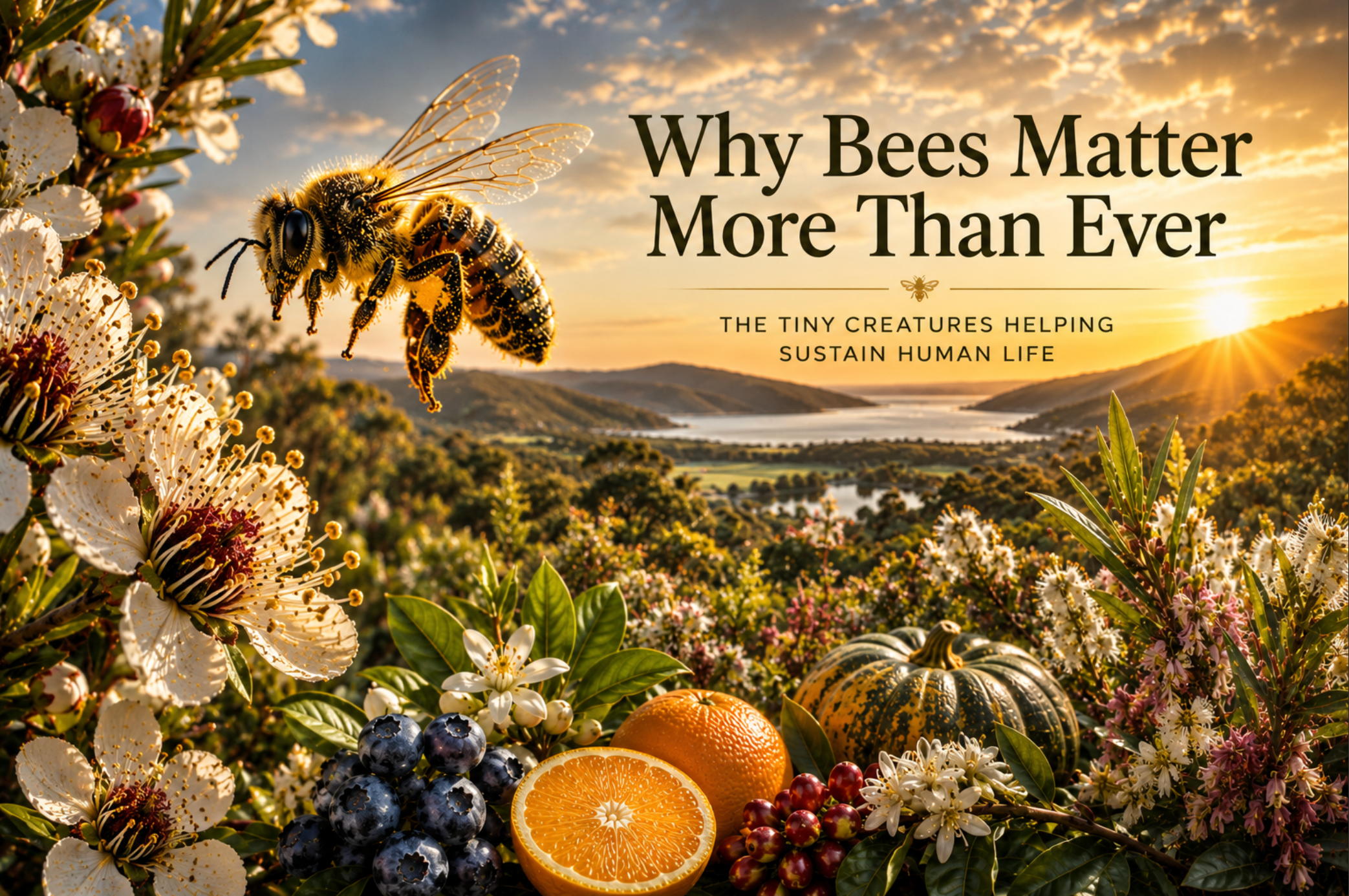
Why Bees Matter More Than Ever: The Tiny Creatures Helping Sustain Human Life
Every day, humans depend on pollinators in ways most of us rarely stop to consider.
It’s estimated that around one-third of global food production relies, at least in part, on pollination — with honey bees playing one of the most important roles.
Without bees, the human diet would look dramatically different.
We would still have staple crops like wheat, rice and corn. But many of the foods that bring colour, flavour, nutrition and diversity to our lives — from apples and berries to avocados, pumpkins, cucumbers, citrus fruits and coffee — would become far less abundant.
In many ways, bees help sustain not just ecosystems, but human life itself.
And they have been doing so for a very long time.
Each year, World Bee Day serves as a reminder of just how important pollinators are to human life, biodiversity and the future resilience of our ecosystems.
More Than 100 Million Years in the Making
Bees and flowering plants are believed to have evolved together for more than 100 million years.
Long before modern agriculture, supermarkets or cities existed, pollinators were already helping shape the biodiversity and ecosystems that would eventually support human civilisation itself.
While humans often think of bees mainly for honey production, their greatest contribution may actually be pollination.
Without pollinators, many ecosystems begin to weaken or collapse. Plants fail to reproduce effectively, biodiversity declines and food systems become less resilient.
One of the smallest creatures on Earth helps support some of the largest systems of life.
The Remarkable Honey Bee
The honey bee, Apis mellifera, is one of nature’s most extraordinary insects.
A honey bee colony functions almost like a single living organism — often referred to as a “superorganism” — with thousands of bees working collectively to support the survival of the hive.
Inside a colony, every bee has a role.
The queen’s primary purpose is reproduction, laying up to 2,000 eggs per day during peak periods.
Worker bees — all female — clean the hive, care for larvae, defend the colony, collect nectar and pollen, regulate hive temperature and produce honey.
Drone bees exist primarily to mate with queens from other colonies, supporting genetic diversity.
But perhaps most remarkable is how bees communicate.
Honey bees perform a behaviour known as the “waggle dance” — a sophisticated movement used to communicate the direction and distance of food sources to other bees within the hive.
Incredible as it sounds, bees can also:
-
navigate using the position of the sun
-
detect polarised light
-
recognise patterns and landmarks
-
regulate hive temperature with precision
-
work collectively without central control
For such a small insect, the honey bee possesses astonishing biological sophistication.
Australia’s Honey Bees and Global Bee Diversity
The European honey bee, Apis mellifera, was introduced into Australia in 1822 when the first managed honey bees arrived in Sydney aboard the ship Isabella from England.
Today, honey bees play a critical role in Australian agriculture and pollination systems.
Australia is also home to one of the world’s most unique honey bee populations on Kangaroo Island in South Australia, where Ligurian honey bees (Apis mellifera ligustica) were introduced from Italy in 1884.
Kangaroo Island remains globally significant due to its strong biosecurity protections and relative isolation from many bee pests and diseases.
While Australia’s honey industry is built primarily around Apis mellifera, the world contains multiple honey bee species adapted to different climates and ecosystems.
In Asia, for example, the Asian honey bee (Apis cerana) has evolved with different environmental pressures and demonstrates stronger natural resistance to some pests, including Varroa mites.
Across the world, bees have adapted to diverse climates, landscapes and ecosystems for millions of years.
10 Remarkable Facts About Honey Bees
1. Honey bees have five eyes
Two large compound eyes and three smaller simple eyes help bees navigate and detect light.
2. Honey bees have four wings
Their forewings and hindwings hook together during flight for remarkable agility.
3. Worker bees are female
Almost every bee seen collecting nectar or pollen is female.
4. Bees communicate through dance
The waggle dance allows bees to share food source locations with astonishing accuracy.
5. A queen may lay thousands of eggs per day
During peak season, a healthy queen can lay up to 2,000 eggs daily.
6. Bees regulate hive temperature
Colonies maintain remarkably stable internal temperatures to protect developing brood.
7. Bees are exceptional navigators
They use sunlight, landmarks and polarised light to navigate over large distances.
8. Honey is naturally stable
Honey is one of the few foods capable of remaining naturally preserved for extraordinarily long periods when stored correctly.
9. Bees help sustain biodiversity
Pollination supports the reproduction of countless flowering plants and ecosystems.
10. Honey bees help feed the world
Honey bees are among the most important agricultural pollinators on Earth.
Honey: One of Humanity’s Oldest Natural Foods
For thousands of years, humans have valued honey not only for its sweetness, but for its role in nourishment, preservation and traditional medicine.
Ancient Egyptians placed honey in tombs, where jars discovered thousands of years later were still remarkably preserved.
In ancient Greece, honey was prized as a source of natural energy and was referenced by Hippocrates in traditional healing practices.
Across Ayurveda, Traditional Chinese Medicine and Indigenous cultures, honey has long been valued as one of nature’s most important natural foods.
Long before refrigeration or processed foods existed, honey was one of the rare foods capable of remaining naturally stable over extended periods due to its unique chemistry.
In many ways, humanity’s relationship with honey stretches back almost as far as civilisation itself.
Australia’s Hidden Pollinators
While honey bees play a critical role in agriculture, Australia is also home to more than 1,700 native bee species.
Many Australians have never even seen one.
Unlike honey bees, many native bees are solitary rather than colony-based, and several species are stingless.
Some of Australia’s most fascinating native bees include:
-
Blue-banded bees
-
Teddy bear bees
-
Carpenter bees
-
Resin bees
-
Stingless native bees
Many native bees are extraordinary pollinators in their own right.
Blue-banded bees, for example, perform “buzz pollination” — vibrating flowers to release pollen from crops such as tomatoes and blueberries.
Together, honey bees and native pollinators help support the extraordinary biodiversity of Australian ecosystems.
The Challenges Facing Bees Today
Despite their importance, bees face increasing pressure globally.
Habitat loss, deforestation, climate instability, monoculture agriculture and disease are all placing strain on pollinator populations.
One of the greatest recent challenges facing honey bees has been the spread of the Varroa mite — a parasite that attacks and weakens honey bee colonies.
Varroa has significantly impacted beekeeping industries around the world and continues to present major challenges within Australia.
At the same time, modern agricultural systems can sometimes create large forage gaps for bees.
Mass monoculture flowering events may provide short bursts of nutrition, but limited year-round biodiversity can place nutritional stress on pollinators over time.
Healthy bee populations depend on diverse flowering ecosystems.
Just like humans, bees require nutritional diversity to remain strong and resilient.
What Gather By Is Trying to Do
At Gather By, bees sit at the centre of everything we do.
Through our expanding Medicinal Honey Forest™ model, we are working to help create healthier long-term ecosystems for bees, biodiversity and future honey production.
This includes:
-
planting high-DHA Australian Leptospermum species
-
supporting diverse flowering systems
-
developing bee fodder strategies
-
improving long-term forage availability
-
helping support stronger pollinator ecosystems
Our vision is not simply about producing premium Manuka honey.
It’s about helping contribute to healthier relationships between plants, pollinators and the landscapes they depend upon.
Healthy bees create healthy ecosystems.
And protecting bees ultimately means protecting far more than honey production alone.
Final Thoughts
Bees don’t just produce honey.
They help sustain life on Earth.
For more than 100 million years, pollinators have helped shape the ecosystems, flowering plants and biodiversity that humanity now depends upon every day.
And yet, despite their importance, many people rarely stop to think about them.
Perhaps World Bee Day serves as an important reminder that protecting bees ultimately means protecting far more than pollinators alone.
Because protecting bees ultimately means protecting biodiversity, ecosystems and the future resilience of life itself.
Frequently Asked Questions
Why are bees important to humans?
Bees play a critical role in pollinating many of the plants that support global food systems, biodiversity and ecosystem health.
What percentage of food depends on pollinators?
It’s estimated that around one-third of global food production relies, at least in part, on pollination.
Are honey bees native to Australia?
No. The European honey bee (Apis mellifera) was introduced to Australia in 1822 and has since become a vital agricultural pollinator.
What is the Varroa mite?
The Varroa mite is a parasitic mite that attacks honey bee colonies and is considered one of the most serious threats facing modern beekeeping globally.
How many native bee species are there in Australia?
Australia is home to more than 1,700 native bee species, many of which are solitary and some of which are stingless.
How do bees communicate?
Honey bees communicate using pheromones and behaviours such as the “waggle dance,” which helps direct other bees to food sources.
Why is honey naturally long-lasting?
Honey’s low moisture content, acidity and natural chemistry make it highly resistant to spoilage when stored correctly.
A Final Note from Gather By
The more we learn about bees, the more extraordinary they become.
At Gather By, our respect for pollinators sits at the centre of everything we do — from supporting healthier ecosystems through our Medicinal Honey Forest™ model to helping educate consumers about the importance of bees in sustaining biodiversity and life itself.
Because protecting bees is ultimately about protecting the future of our natural world.
Written by Matt Blomfield
Founder, Gather By Australian Manuka Honey

Laisser un commentaire
Ce site est protégé par hCaptcha, et la Politique de confidentialité et les Conditions de service de hCaptcha s’appliquent.