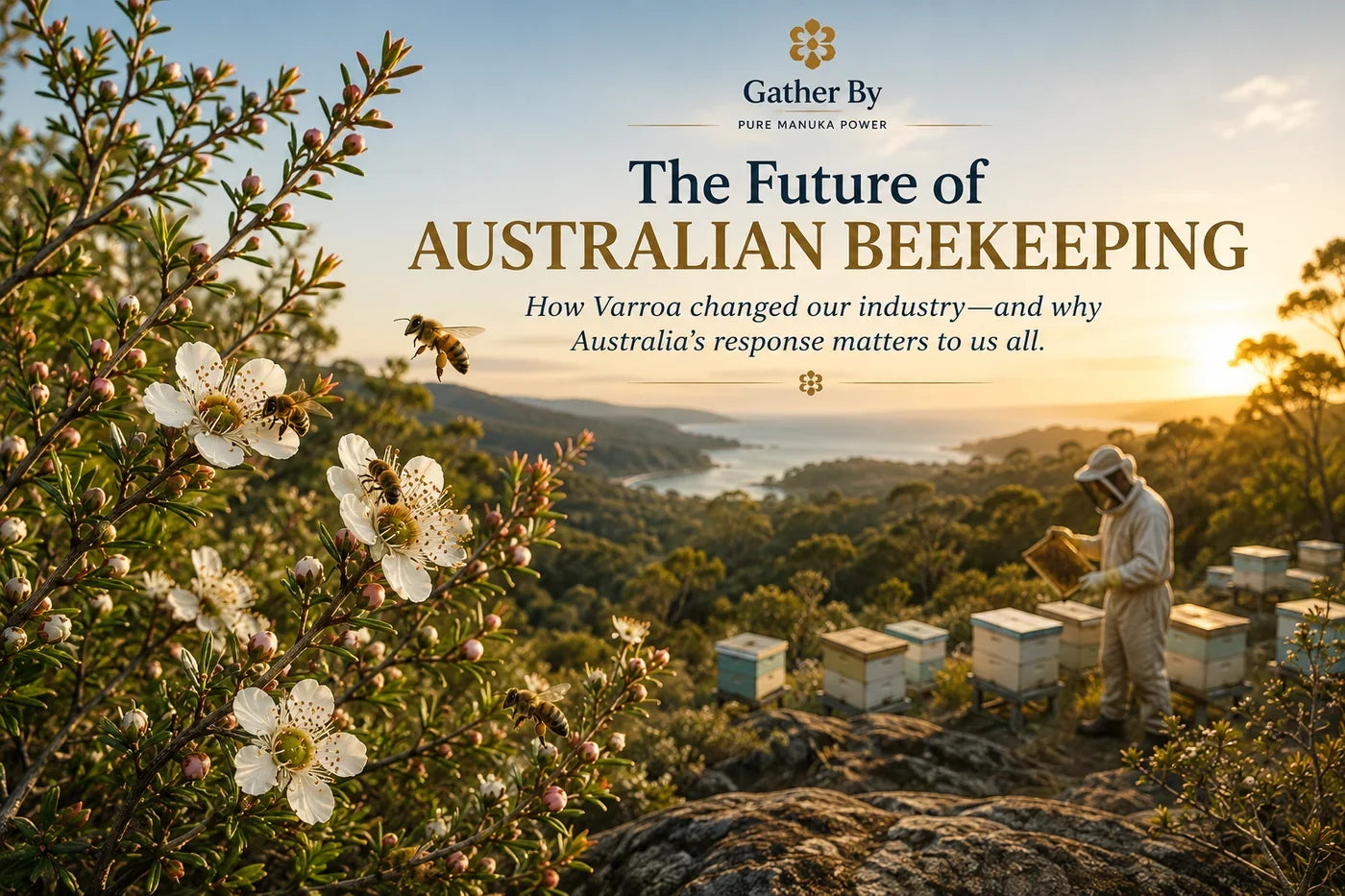
The Future of Australian Beekeeping
How Varroa changed our industry forever and why there is still hope
Why healthy bees, biodiversity and food security matter more than ever.
Reading time: 8 minutes
A Decade That Changed Everything
More than a decade ago, Gather By was founded at a time when Australia held a remarkable distinction.
It was the last major beekeeping nation on Earth free from Varroa destructor—the tiny parasitic mite regarded as one of the greatest threats to honey bees worldwide.¹
At the time, few Australians had heard of Varroa, and fewer still needed to.
Healthy honey bee colonies quietly pollinated farms, orchards and native landscapes while producing some of the purest honey in the world. Australian beekeepers enjoyed something every other major beekeeping nation had already lost—a unique biosecurity advantage.
Those working closely with bees understood, however, that Australia's geographic isolation would not provide permanent protection.
When Varroa was first detected near the Port of Newcastle in June 2022, Australian beekeeping entered a new chapter. Following an intensive national eradication effort, Australia transitioned to long-term management in September 2023, joining every other major beekeeping nation in learning to live with the mite.²
The industry changed almost overnight.
Yet there is good reason for optimism.
Australian agriculture has repeatedly demonstrated an extraordinary ability to innovate, adapt and overcome significant challenges. The resilience and ingenuity of Australian beekeepers continue that tradition today.
Gather By was established during this unique period with a purpose extending well beyond producing premium Australian Manuka honey.
From the beginning, the vision centred on Australia's long-term food security.
Healthy food systems depend on healthy pollinators.
Healthy pollinators depend on skilled beekeepers who can build sustainable businesses.
Without commercially viable beekeepers, Australia risks losing far more than honey. It risks weakening the pollination services that underpin much of the nation's food production.
That principle has guided Gather By from its earliest days and continues to shape every decision made today.
More Than Honey
Most people associate bees with honey.
The reality is that honey may be their smallest contribution.
Honey bees are among Australia's most important pollinators, helping support around 65% of Australia's horticultural and agricultural crops while contributing an estimated $4.6 billion to Australian agriculture every year through pollination services.¹
It's often said that one in every three mouthfuls of food we eat depends, in some way, on bee pollination.¹
Pause for a moment and consider that.
Every third mouthful.
From almonds and apples to berries, avocados, macadamias and countless other crops, healthy pollinators quietly support the food that appears on Australian tables every day.
Australia is also blessed with extraordinary biodiversity.
The continent is home to more than 1,700 species of native bees.³ While most don't produce honey, they perform an equally important role pollinating native plants and helping maintain resilient ecosystems alongside the European honey bee.
Healthy food doesn't begin at the supermarket.
It begins with healthy landscapes.
Healthy soils.
Healthy waterways.
Healthy forests.
Healthy pollinators.
Each depends upon the other.
When one part of the system weakens, the effects are felt across the entire landscape.
The Tiny Mite With Enormous Consequences
Varroa destructor is a tiny external parasite that feeds on honey bees and developing brood.
Although almost invisible to the naked eye, its impact is profound.
It weakens colonies, spreads harmful viruses and dramatically increases the time, cost and expertise required to maintain healthy hives.
Around the world, Varroa has transformed the practice of beekeeping.
Australia simply encountered that challenge later than most.
The arrival of Varroa did not signal the end of Australian beekeeping.
It marked the beginning of a new chapter.
One demanding greater vigilance.
Greater knowledge.
Greater investment.
And closer collaboration between beekeepers, researchers and government agencies.
Healthy colonies now require more active management than ever before.
That reality has reshaped the industry—but it has also accelerated innovation.
The Almond Pollination Challenge
Modern agriculture depends upon healthy pollinators.
One of the best examples is Australia's almond industry.
Each winter, approximately 300,000 managed honey bee hives are transported from across eastern Australia to pollinate almond orchards—one of the largest annual livestock movements in the country.⁴
That pollination is essential.
Without healthy honey bee colonies, Australia's almond industry simply could not achieve the yields it does today.
Once Varroa became established, however, those same seasonal movements also created opportunities for the mite to spread more rapidly between regions.
It's important to understand that the almond industry did not introduce Varroa into Australia.
But once the mite arrived, the annual movement of large numbers of managed hives became one of the pathways through which it spread across eastern Australia.
The challenge highlights just how interconnected Australia's food system has become.
The pollination services that support billions of dollars in agricultural production also depend on maintaining resilient honey bee populations.
Protecting one ultimately helps protect the other.
An Industry Being Reshaped
Australian beekeeping is entering one of the most significant periods in its history.
Researchers continue developing improved monitoring systems, more effective treatment options and breeding programs aimed at increasing colony resilience.
Government agencies continue strengthening surveillance, biosecurity and education.
Across the country, beekeepers continue adapting with remarkable determination.
The industry is evolving because it has to.
International experience has shown that unmanaged (feral) honey bee populations can decline dramatically once Varroa becomes established, reducing the "free pollination" they once provided across forests, farms and native landscapes.⁵
That places even greater importance on professionally managed honey bee colonies.
At the same time, Australia's extraordinary biodiversity must never be taken for granted.
The nation's native pollinators—including more than 1,700 species of native bees—also face increasing pressure from habitat loss, land clearing, changing climate patterns and fragmented landscapes.³
Protecting biodiversity is no longer simply an environmental issue.
It is fundamental to the resilience of Australia's food system.
Healthy landscapes support healthy pollinators.
Healthy pollinators support healthy agriculture.
The connection has never been clearer.
A Different Way Forward
Long before Varroa arrived in Australia, another question was already being explored.
Could healthier landscapes help create a stronger future for bees?
That question became the foundation of the Medicinal Honey Forest™.
More than a decade ago, the objective wasn't to respond to Varroa. Australia was still proudly free of the mite.
Instead, the focus was on creating permanent Australian Manuka landscapes capable of delivering exceptional nectar while restoring biodiversity and strengthening regional agriculture.
The concept was deliberately simple.
Rather than continually transporting bees to follow unpredictable flowering events, could carefully selected Australian Manuka varieties provide reliable forage across early, mid and late flowering seasons?
Could bees remain in situ—living where they forage—while benefiting from abundant nutrition and carefully managed landscapes?
Could biodiversity become part of commercial beekeeping rather than something existing around it?
Those questions remain just as relevant today.
Thriving bee colonies depend upon diverse nutrition, clean water, healthy habitat and thoughtful management.
The Medicinal Honey Forest™ is not presented as the answer to every challenge facing Australian beekeeping.
Far from it.
Varroa will continue demanding vigilance.
Science will continue evolving.
Beekeepers will continue adapting.
Yet experience continues to suggest that healthier landscapes contribute to stronger pollinator populations, and stronger pollinator populations help build healthier landscapes in return.
Nature has always worked that way.
Supporting Australian Beekeepers
Gather By was founded on a simple belief.
Australia's long-term food security depends not only on healthy pollinators, but also on commercially sustainable beekeepers.
Without skilled beekeepers, there are no managed honey bee colonies.
Without managed honey bee colonies, much of the pollination that underpins Australian agriculture becomes increasingly vulnerable.
Supporting the people who care for Australia's bees is therefore just as important as caring for the bees themselves.
For many years, much of the global honey market has operated as a commodity market, where honey is often valued primarily by volume rather than quality.
Exceptional honey can require significantly more time, knowledge and careful hive management to produce, yet historically those efforts have not always been reflected in the price paid to the beekeeper.
Australian Manuka created an opportunity to think differently.
Rather than purchasing honey simply by weight, Gather By purchases Australian Manuka according to its independently verified MGO rating.
This approach recognises the naturally occurring bioactive activity of the honey while also rewarding the care, patience and expertise required to consistently produce premium Australian Manuka.
It's a partnership model rather than simply a purchasing model.
One designed to recognise quality, encourage continual improvement and return greater value to the people whose knowledge underpins Australia's pollination system.
Looking back, the Medicinal Honey Forest™ was never simply about planting Australian Manuka.
It was about helping create healthier landscapes, stronger regional businesses and a more resilient future for Australian beekeeping.
Why Authentic Honey Matters
As Australian beekeeping becomes more challenging, another issue deserves increasing attention.
Authenticity.
Around the world, honey is recognised as one of the most frequently adulterated foods.⁶ International investigations continue to identify honey that has been diluted, blended or misrepresented, making it increasingly difficult for consumers to know exactly what they're purchasing.
That matters.
When honey appears unusually inexpensive, it's worth asking a few simple questions.
Where was it produced?
Can it be traced back to the beekeeper?
Has it been independently tested?
Does it genuinely contain what the label claims?
Every consumer deserves confidence in the answers.
That's why traceability has become one of the defining principles of Gather By.
Every batch of Australian Manuka honey is independently laboratory tested to verify its MGO rating.
Every jar is fully traceable from Hive to Home™.
Every product carrying the Australian Manuka Honey Association's Mark of Authenticity can be independently verified, giving consumers confidence that what's on the label is exactly what's inside the jar.
Authenticity isn't simply about compliance.
It's about trust.
And trust has become one of the most valuable ingredients in food.
Choosing authentic Australian Manuka honey isn't simply a purchasing decision.
It's also a way of supporting Australian beekeepers, regional communities and an industry that plays a vital role in producing the food found on Australian tables every day.
Every Jar Builds Something Bigger
The journey that began more than a decade ago continues today with an even greater sense of purpose.
Australia is approaching an important moment in the evolution of its food system.
One path leads towards increasingly simplified agricultural landscapes, expanding monocultures and growing pressure on the natural systems that support food production.
The other embraces biodiversity, resilient farming systems and landscapes designed to work with nature rather than against it.
Gather By has chosen the second path.
Every jar of Australian Manuka honey contributes to something much larger than the honey itself.
It helps support ongoing investment in the Medicinal Honey Forest™, working alongside landholders, researchers, beekeepers and regional communities to establish healthier bee habitat, strengthen biodiversity and improve the resilience of Australian agriculture.
It's a community-centred agribusiness model founded on a simple philosophy.
Healthy landscapes support thriving pollinators.
Thriving pollinators help produce healthy food.
Healthy food supports healthy communities.
Each depends upon the other.
If food truly is medicine, then medicine begins long before it reaches our plate.
It begins with healthy soils.
Healthy plants.
Healthy pollinators.
Healthy ecosystems.
And the choices made every day by growers, beekeepers and consumers alike.
Every purchase becomes a vote for the future we hope to leave the next generation.
Australian Beekeeping at a Glance
Australia's honey bees are about far more than honey.
-
🐝 One in every three mouthfuls of food depends, in some way, on bee pollination.¹
-
🌼 Honey bees help pollinate around 65% of Australia's horticultural and agricultural crops, contributing an estimated $4.6 billion to Australian agriculture every year.¹
-
🇦🇺 Australia has approximately 1,800 commercial beekeepers managing around 855,000 hives.¹
-
📅 Australia remained free of Varroa destructor until its first detection in June 2022.²
-
🌿 Australia is home to more than 1,700 native bee species, many of which play a vital role in maintaining healthy ecosystems.³
Frequently Asked Questions
Why are honey bees so important?
Honey bees do far more than produce honey. They help pollinate around 65% of Australia's horticultural and agricultural crops, contributing an estimated $4.6 billion to Australian agriculture each year. It's often said that one in every three mouthfuls of food we eat depends, in some way, on bee pollination. Healthy pollinators help produce many of the fruits, vegetables, nuts and seeds enjoyed every day.
What is Varroa destructor and why has it changed Australian beekeeping?
Varroa destructor is a tiny parasitic mite that attacks honey bees, weakens colonies and spreads harmful viruses. Since its first detection in Australia in June 2022, it has fundamentally changed beekeeping by increasing the need for hive monitoring, biosecurity and ongoing management. Australian beekeepers continue adapting with remarkable resilience as they respond to this challenge.
What is the Medicinal Honey Forest™?
The Medicinal Honey Forest™ is Gather By's long-term vision for creating permanent Australian Manuka landscapes that support thriving pollinators, stronger biodiversity and more resilient food systems. By providing reliable flowering, abundant nutrition and permanent habitat, the model aims to work with nature to strengthen both bee health and landscape resilience.
Why does Gather By purchase honey based on MGO?
Traditional honey has often been traded as a commodity, where exceptional honey received little additional recognition beyond its weight. Gather By purchases Australian Manuka honey according to its independently verified MGO rating, recognising the skill, care and knowledge required to produce premium Australian Manuka while helping return greater value to Australian beekeepers.
How can consumers be confident their Manuka honey is authentic?
Every batch of Gather By Australian Manuka honey is independently laboratory tested, fully traceable from Hive to Home™, and products carrying the Australian Manuka Honey Association's Mark of Authenticity can be independently verified. It's a commitment to ensuring that what's on the label is exactly what's inside the jar.
How can Australians help support bees and biodiversity?
Every choice makes a difference. Choosing authentic Australian honey, supporting local beekeepers, planting flowering native species and valuing biodiversity all contribute to healthier pollinators and more resilient food systems. Together, those choices help build a stronger future for Australian agriculture.
Looking Ahead
Australia's beekeeping industry is entering one of the most important periods in its history.
The decisions made today will influence the health of our pollinators, the resilience of our food systems and the biodiversity of our landscapes for decades to come.
Supporting Australian beekeepers.
Rewarding quality.
Investing in biodiversity.
Protecting authentic food.
These are not separate ambitions.
They are all part of the same story.
Gather By was established with that long-term vision in mind.
Not simply to produce premium Australian Manuka honey, but to help strengthen Australia's food security by supporting healthier pollinators, commercially sustainable beekeeping and landscapes that continue to nourish future generations.
The arrival of Varroa has reminded Australia that healthy pollinators cannot be taken for granted.
Neither can healthy landscapes.
Nor the dedicated beekeepers who care for them.
Every Medicinal Honey Forest™ established...
Every beekeeper supported...
Every jar of authentic Australian Manuka honey produced...
Represents another investment in a stronger, more resilient future.
Because in the end, this story isn't really about honey.
It's about protecting one of Australia's most valuable natural partnerships—between healthy landscapes, thriving pollinators and the food that reaches every Australian table.
That future belongs to all of us.
Continue the Journey
If this article has given you a greater appreciation for Australian beekeeping and authentic Australian Manuka honey, we'd love to help you continue the journey.
Whether you're discovering Manuka for the first time or looking to understand which MGO rating best suits your individual needs, our team is here to help.
Our current Winter Wellness Collection includes 20% off selected MGO 300+, MGO 600+ and MGO 1200+ Australian Manuka honeys, with free delivery Australia-wide.
Simply use the code JULY20 at checkout.
Prefer to speak with someone?
Julie has personally assisted more than 10,000 customers, helping people understand Australian Manuka honey through years of experience and the shared wisdom gained from thousands of conversations.
Monday to Friday | Business Hours
Or leave a message and she'll return your call as soon as possible.
Thank you for supporting Australian beekeepers, healthier landscapes and a more resilient future for Australian food.
References
1] Australian Honey Bee Industry Council (AHBIC). The Importance of Honey Bees. Pollination statistics including one in three mouthfuls of food, 65% of horticultural and agricultural crops, annual pollination contribution, and Australian commercial hive numbers.
2] NSW Department of Primary Industries. Varroa Mite Response. Timeline covering Australia's first detection in June 2022 and the transition from eradication to long-term management.
3] Australian Museum. Native Bees of Australia. Reference for Australia's 1,700+ native bee species and their ecological importance.
4] Australian Almond Board & Australian Honey Bee Industry Council. Information relating to annual managed hive movements for almond pollination.
5] Australian Colony Loss Survey, Australian National University and international Varroa research. Research describing the impacts of Varroa on managed and unmanaged honey bee populations.
6] International honey authenticity and food fraud research. Studies highlighting honey as one of the world's most frequently adulterated foods and the importance of traceability and independent testing.

Jätä kommentti
Tämä sivu on suojattu hCaptcha-tunnistuksella, ja hCaptchan tietosuojakäytäntöjä ja käyttöehtoja sovelletaan.