
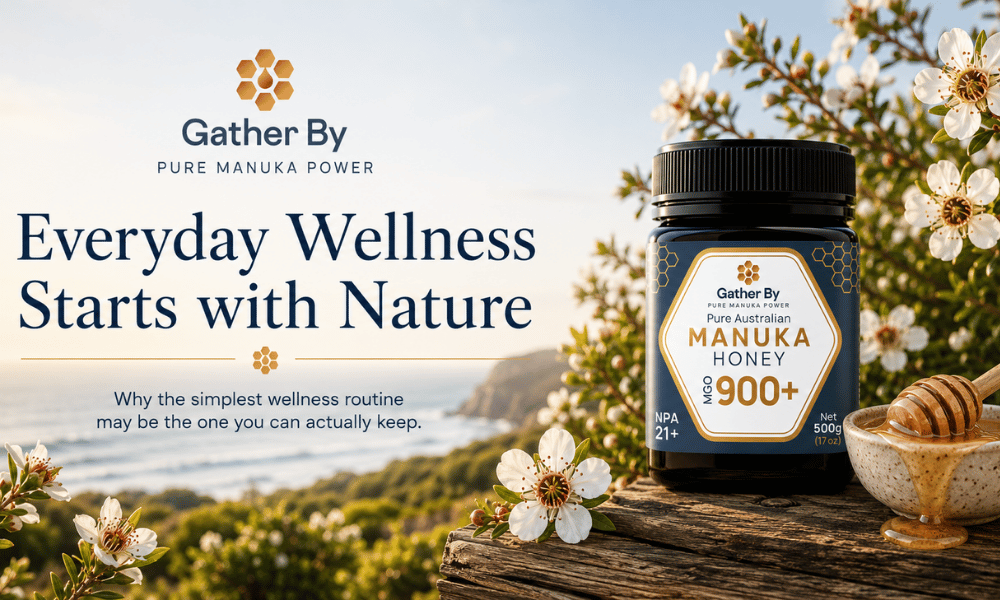
Everyday Wellness Starts with Nature
Why the simplest wellness routine may be the one you can actually keep.
Reading time: 6 minutes
Wellness has become complicated.
There's always something new to try. A new routine. A new supplement. A new diet. A new app. A new piece of technology promising to help us sleep, move, eat or live better.
Yet perhaps National Wellness Month is an opportunity to ask a much simpler question:
What can we realistically do every day?
Because wellbeing isn't built around what we do occasionally. More often, it's shaped by the small things we're able to repeat.
Eating well. Moving our bodies. Drinking enough water. Sleeping properly. Spending time outside. Connecting with people we care about. Finding moments in the day to slow down.
None of these ideas is particularly revolutionary.
Perhaps that's precisely the point.
Small Things, Repeated
When it comes to wellbeing, consistency can be more useful than complexity.
The World Health Organization recommends adults undertake 150–300 minutes of moderate physical activity each week, but it also makes an important point that sometimes gets lost amongst the numbers: some physical activity is better than none, and people can begin with small amounts and gradually build from there.¹
Australian dietary guidance is similarly grounded in everyday behaviour: enjoy a wide variety of nutritious foods from the five food groups and drink plenty of water.²
The fundamentals aren't particularly exotic.
The challenge is making them part of our lives.
A ten-minute walk that's actually taken may be more useful than an ambitious exercise plan that never begins.
A good breakfast tomorrow morning is achievable.
Going outside for half an hour is achievable.
Going to bed a little earlier is achievable.
The question becomes less about creating the perfect wellness routine and more about creating one we're happy to repeat.
Why Simple Habits Are Easier to Keep
There is interesting science behind this.
In a well-known University College London study, participants chose a simple eating, drinking or activity behaviour and repeated it in the same context each day—for example, doing something after breakfast.
As the behaviour was repeated, it became progressively more automatic. Importantly, there was enormous variation in how long that took: from 18 to 254 days among participants whose habit-formation curves could be modelled. Missing one opportunity also didn't materially derail the process.³
So forget the popular idea that everyone forms a habit in 14 or 21 days.
There is no magic number.
What the research does reinforce is something much more useful: repetition and context matter.
That gives us a wonderfully uncomplicated starting point:
Make it simple. Make it enjoyable. Make it repeatable.
Rather than completely redesigning your day, attach something positive to a routine that's already there.
A glass of water when you wake.
A walk after lunch.
A little time outside with your morning coffee.
A better bedtime routine.
A favourite natural food with breakfast.
Small actions have somewhere to belong—and that makes tomorrow's repetition a little easier.
What Can Change in 14 Days?
Can 14 days completely transform your health?
Probably not—and wellness shouldn't be sold that way.
But two weeks can provide something much more realistic: an opportunity to consciously practise doing something differently.
Choose one small thing.
Perhaps it's walking every morning.
Perhaps it's eating breakfast instead of rushing out the door.
Perhaps it's putting your phone away earlier in the evening.
Perhaps it's spending more time outdoors.
Perhaps it's simply taking ten minutes each day for yourself.
Don't aim for perfection.
Just notice what happens when you give one positive behaviour a regular place in your day.
And if you miss a day?
Start again tomorrow.
That's not failure. That's life.
Nature Has a Way of Keeping Things Simple
Nature works through rhythm.
Day and night.
Flowering and dormancy.
Rain and sunshine.
Growth and renewal.
Perhaps that's one reason spending time outside can feel so restorative.
A large 2019 study involving almost 20,000 people found that spending at least 120 minutes a week in nature was associated with a greater likelihood of reporting good health and high wellbeing. Interestingly, it didn't appear to matter whether those two hours happened in one visit or were spread across several shorter visits.⁴
That doesn't mean everyone needs another target to achieve.
Quite the opposite.
Two hours across seven days might simply mean a walk along the beach, some gardening, sitting in the morning sun or spending part of the weekend in the bush.
Nature doesn't need to become another item on the wellness checklist.
Sometimes we just need to go outside.
Food Can Be a Ritual Too
Food is one of our oldest daily rituals.
We gather around it. Prepare it. Share it. Celebrate with it.
And some of the most enduring food rituals are remarkably simple.
Australian Manuka honey can be enjoyed in much the same way—as a natural food that becomes part of an existing routine.
A teaspoon straight from the jar.
With breakfast or yoghurt.
In a smoothie.
With fruit.
Or stirred into a warm—not boiling—drink.
At Gather By, we often hear from customers who have developed their own way of enjoying Manuka each day.
There's no complicated program required.
One spoonful. One simple daily ritual.
Australian Manuka honey should, of course, be enjoyed as part of a varied, balanced diet rather than viewed as a substitute for the fundamentals of good nutrition. Australian dietary guidance reminds us that no single food provides everything our bodies need.²
Why MGO Matters
Not all Manuka honey is the same.
MGO stands for methylglyoxal, the naturally occurring compound widely used to measure the characteristic antibacterial activity of Manuka honey.
The number on the jar indicates the minimum concentration of MGO in milligrams per kilogram of honey.
So MGO900+ means the honey has been independently tested to contain at least 900 mg/kg of MGO.
For consumers, that provides something valuable: a measurable way to understand what they're purchasing.
At Gather By, every batch is independently tested and certified for MGO and NPA, helping ensure the honey inside the jar matches what is stated on the label.
Wellness Starts Before the Jar
For Gather By, the idea of wellness begins long before someone opens a jar of honey.
It begins in the landscape.
With flowering Australian Manuka.
With bees gathering nectar.
With beekeepers caring for their colonies.
With healthy habitat, biodiversity and thoughtful land management.
Then comes harvesting, careful handling, independent testing, authentication and traceability before the honey eventually reaches someone's kitchen.
It's a journey from nature to home.
And it reminds us of something easily forgotten in a world increasingly dominated by manufactured wellness products:
Good food begins with good ingredients—and good ingredients begin with healthy landscapes.
Frequently Asked Questions
What is National Wellness Month?
National Wellness Month is recognised during August and encourages people to consider the everyday choices and routines that contribute to their wellbeing. For us, it's a useful reminder that wellness doesn't need to mean completely changing the way we live.
What are some simple everyday wellness habits?
Regular movement, adequate sleep, nutritious food, hydration, social connection and spending time outdoors are good places to begin. WHO also emphasises that when it comes to movement, some physical activity is better than none.¹
How can I make a wellness routine easier to maintain?
Start small and make the behaviour easy to repeat. Research into habit formation suggests repeating a behaviour within a consistent context helps it become more automatic over time.³
Can Australian Manuka honey be part of an everyday routine?
Yes. Manuka is first and foremost a natural food. Many people enjoy a teaspoon from the jar or add it to breakfast, yoghurt, smoothies or warm drinks as part of their normal routine.
What does MGO900+ mean?
MGO900+ indicates that the Manuka honey has been tested to contain at least 900 mg of methylglyoxal per kilogram. Gather By independently tests and certifies every batch for MGO and NPA.
Start With One Thing
Perhaps the most useful thing we can do during National Wellness Month isn't add another complicated routine to our lives.
Perhaps it's simply to choose one thing.
Something small enough to do today.
And tomorrow.
And the day after that.
A walk. A better breakfast. More time outdoors. An earlier night. A conversation with someone we care about. A spoonful of something nature made.
Wellness doesn't have to be perfect.
It doesn't have to be fashionable.
And it certainly doesn't have to happen overnight.
Everyday wellness starts with the small things we choose to make part of every day.
Make Australian Manuka Part of Your Everyday
Discover Gather By's independently tested and authenticated Australian Manuka Honey MGO900+, and make one simple natural ritual part of your day.
Not Sure Which MGO Is Right for You?
Sometimes it's easier to simply talk to someone.
Julie has personally helped more than 10,000 customers understand Australian Manuka honey and choose an MGO that suits their individual needs.
Call Julie on 1300 849 080
Monday–Friday | Business Hours
Or leave a message and she'll return your call as soon as possible.
Here’s to the small things we do every day—and the difference they can make over time.
Matt Blomfield
Founder & CEO
References
1. World Health Organization. WHO Guidelines on Physical Activity and Sedentary Behaviour. Adults are recommended to undertake 150–300 minutes of moderate-intensity aerobic physical activity per week, with WHO emphasising that some activity is better than none.
2. Australian Government / NHMRC. Australian Dietary Guidelines and Australian Guide to Healthy Eating. Guidance recommends a wide variety of nutritious foods from the five food groups and adequate water as the foundation of healthy eating.
3. Lally, P., van Jaarsveld, C.H.M., Potts, H.W.W. & Wardle, J. How are habits formed: Modelling habit formation in the real world. European Journal of Social Psychology, 40, 998–1009. The study found substantial individual variation in the time required for behaviours to become automatic and demonstrated the importance of repetition in a consistent context.
4. White, M.P. et al. Spending at least 120 minutes a week in nature is associated with good health and wellbeing. Scientific Reports 9, 7730 (2019). Study of 19,806 participants found an association between spending at least 120 minutes per week in nature and greater likelihood of reporting good health and wellbeing.

Jätä kommentti
Tämä sivu on suojattu hCaptcha-tunnistuksella, ja hCaptchan tietosuojakäytäntöjä ja käyttöehtoja sovelletaan.