
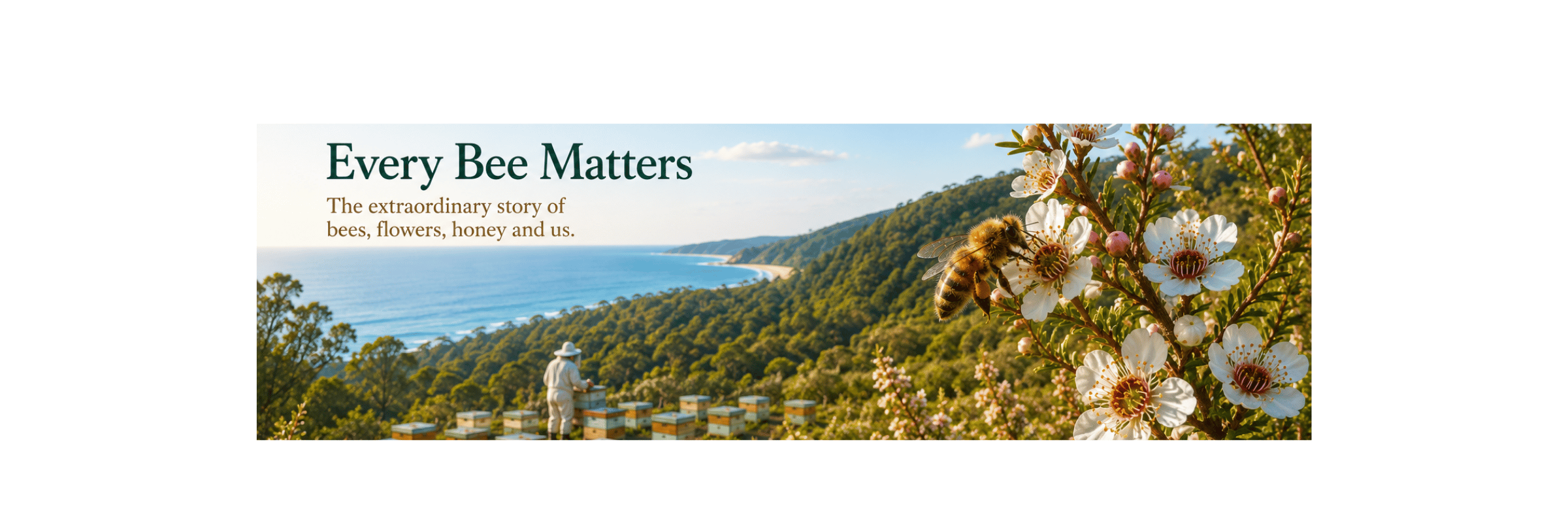
Every Bee Matters
The extraordinary story of bees, flowers, honey and us.
Long before humans cultivated their first crop, built their first hive or tasted their first spoonful of honey, bees were already here.
Current evolutionary research places their origins at around 120 million years ago, during a remarkable period in Earth's history when flowering plants were diversifying across the planet. Bees evolved from wasp-like ancestors, and somewhere along that evolutionary journey an extraordinary change occurred: rather than hunting other insects for food, their ancestors increasingly gathered pollen and nectar from flowers.
- What followed became one of nature's great partnerships.
- Flowers provided food.
- Bees carried pollen.
- Plants reproduced and diversified.
- And millions of years later, humans became part of the story.
Not All Bees Make Honey
When we think of a bee, many of us picture the familiar European honey bee, Apis mellifera, living in a large colony around a queen and producing comb filled with honey.
But that's only one chapter in an enormous story.
Australia alone has more than 1,600 recognised native bee species. Most are solitary or semi-social rather than living in the enormous organised colonies we associate with European honey bees. They make their homes in soil, timber, small hollows, resin and mud. Only a handful of Australia's social native bee species produce honey.
Some are tiny. Others are colourful, metallic or furry. They have evolved different relationships with different plants and perform important roles within Australia's ecosystems.
So when we say every bee matters, we're talking about much more than honey.
We're talking about biodiversity.
Then Something Extraordinary Happened: Honey
For certain social bees, nectar presented both an opportunity and a problem.
Flowers can provide enormous amounts of energy-rich nectar, but flowering doesn't last forever.
Honey bees developed an ingenious solution.
They collect nectar, transport it back to the colony, transform it through enzymatic activity and progressively reduce its moisture content before storing it in wax cells.
The result is honey: a concentrated source of energy that can be stored and used when flowers aren't producing nectar.
Honey wasn't created for humans.
It was the bees' pantry.
But eventually another species discovered it.
Us.
Humans Discover the Bees' Pantry
Our relationship with honey stretches deep into human history.
Long before refined sugar existed, people were prepared to climb trees and cliffs and confront thousands of defensive insects to obtain this extraordinary concentrated source of sweetness.
Over time, humans learned to do something even more remarkable: rather than simply finding wild colonies and taking their honey, we began keeping bees.
Evidence of organised beekeeping extends back thousands of years. Ancient Egyptian depictions show sophisticated apiculture, while archaeological discoveries elsewhere in the ancient Near East reveal purpose-built apiaries.
Honey became far more than something sweet.
It became food.
A valuable commodity.
An ingredient in traditional preparations.
An offering in religious and ceremonial practices.
And a substance that appeared in ancient approaches to wound care and medicine.
For much of human history, honey wasn't regarded as an ordinary commodity.
It was something worth seeking, storing, trading and protecting.
From Honey Hunters to Beekeepers
As humans learned to house and manage colonies, our relationship with bees changed again.
We became, to some extent, custodians of the hive.
Over centuries, beekeeping became increasingly sophisticated. Eventually came movable-frame hives, commercial honey production and the movement of managed colonies specifically to pollinate crops.
The original relationship had been beautifully simple:
Flower → Bee
Humans added another dimension:
Flower → Bee → Human
And modern agriculture eventually added another:
Bee → Pollination → Food system
Today, honey bees contribute to the pollination of crops around the world.
But here in Australia, the story took a particularly interesting turn.
Australia Already Had Its Own Bee Story
Australia's native bees had been interacting with our extraordinary flowering plants for millions of years before European settlement.
Then another bee arrived.
The European honey bee was introduced to Australia in 1822 (15 years prior to New Zealand) and adapted remarkably well to its new environment. Australia's abundant flowering vegetation provided extensive forage, and honey bees spread beyond managed hives into the landscape.
Within about a decade of their introduction, substantial feral populations had become established.
Over the following two centuries, European honey bees became integral to Australian beekeeping, honey production and agricultural pollination.
Yet Australia remained different from virtually every other major beekeeping nation in one crucial respect.
We didn't have Varroa.
Then Varroa Changed the Story
Varroa destructor is a parasitic mite that attacks European honey bees, weakening colonies and transmitting damaging viruses.
For decades, Varroa spread through the world's major beekeeping regions including New Zealand while Australia remained extraordinarily fortunate.
Prior to its establishment here, Australia was the only populated continent free of Varroa, and government biosecurity material recognised the extraordinary importance of maintaining that status.
Then, in June 2022, Varroa was detected in New South Wales.
That changed Australian beekeeping forever.
Managed colonies can be monitored and treated. Unmanaged European honey-bee colonies have no beekeeper looking after them, making the arrival of Varroa particularly significant for the feral populations that had existed across Australian landscapes for generations.
We explored that changing world in detail in our recent article, The Future of Australian Beekeeping.
But in the much longer history of bees, Varroa is another reminder of something nature has demonstrated repeatedly:
resilience depends on diversity, habitat and healthy ecosystems.
An Extraordinary Australian Relationship
Among the countless relationships honey bees formed with Australian plants was one that would eventually reveal something remarkable.
Australia is home to extraordinary diversity within this native plant group. Its distinctive flowers—typically five-petalled, with prominent stamens—provide nectar and pollen for visiting bees.
And within the nectar of certain Australian Leptospermum species is a naturally occurring compound called dihydroxyacetone, or DHA.
When bees collect that nectar and turn it into honey, something fascinating happens over time.
DHA progressively gives rise to methylglyoxal—MGO.
MGO is the compound now widely used as a measure of the characteristic antibacterial activity associated with Manuka honey.
Research involving Professor Peter Brooks and colleagues has continued to deepen our understanding of Australian Manuka. A 2024 study examining Australian and New Zealand honeys detected the Manuka markers leptosperin, DHA and MGO across the tested Leptospermum-derived honeys. Some Australian samples recorded particularly high concentrations of these compounds.
It is an extraordinary natural progression:
Flower → Nectar → Bee → Honey → MGO
Something that began as a relationship between flowering plants and insects millions of years ago eventually produced a food whose chemistry humans are still learning to understand.
What 120 Million Years Can Teach Us
Perhaps the most important lesson in this story isn't about honey at all.
It's about diversity.
Different plants.
Different flowering periods.
Different bees.
Different habitats.
Reliable nutrition.
Healthy landscapes.
Nature rarely builds resilience around a single species or a single food source.
That's one of the principles behind Gather By's Medicinal Honey Forest™ model: establishing diverse Australian Manuka plantings, encouraging biodiversity and keeping managed bees close to abundant forage rather than viewing the hive in isolation from the landscape around it.
We're still learning.
But perhaps the future of beekeeping requires us to relearn some of the lessons nature worked out millions of years before we arrived.
Why Every Bee Matters
Honey bees matter.
Native bees matter.
Solitary bees matter.
Stingless bees matter.
The flowers supporting them matter.
And the landscapes connecting everything together matter.
Not every bee needs to make honey to be valuable.
Australia's native bees are part of an extraordinarily diverse pollinator community, while managed European honey bees now play an important role in our agricultural food system.
Their stories are different.
But together they remind us that pollination isn't simply an agricultural service.
It is an ecological relationship that began long before agriculture existed.
Frequently Asked Questions
How old are bees?
Current evolutionary research indicates bees originated roughly 120 million years ago, evolving from wasp-like ancestors during the diversification of flowering plants.
Do all bees make honey?
No. Most bee species don't produce the large stores of honey associated with European honey bees. Australia has more than 1,600 recognised native bee species, most of which are solitary or semi-social.
When did European honey bees arrive in Australia?
European honey bees were introduced to Australia in 1822. They adapted successfully and subsequently became important to Australian honey production and agricultural pollination.
Why is Varroa so significant?
Varroa destructor is a parasitic mite of European honey bees that weakens colonies and transmits viruses. Australia remained free of established Varroa until 2022, making its arrival a fundamental change for Australian beekeeping.
What makes Australian Manuka honey different?
Australian Manuka comes from the nectar of Leptospermum plants. Certain species produce nectar containing DHA, which gives rise to MGO as the honey matures. Australian research has demonstrated considerable diversity in DHA, MGO and other Manuka markers across different Leptospermum species and honeys.
A Story Much Older Than Us
Bees have survived enormous changes to the planet.
They were here tens of millions of years before us.
Flowers and bees had already established one of nature's great partnerships long before humans planted their first crop, built their first hive or tasted their first spoonful of honey.
We became part of their story much later.
Today, we depend upon bees not only for honey, but for pollination, food production and the health of ecosystems around us.
That makes our role in the next chapter important.
Perhaps our responsibility is simply to make sure we're not the generation that breaks a partnership more than 100 million years in the making.
Discover Australian Manuka
Every jar of Gather By Australian Manuka begins with that same ancient relationship between flower and bee.
Our honey is independently tested, authenticated and traceable from Hive to Home. Contact us to learn more about our Australian Manuka and the care behind every jar.
Matt Blomfield
Founder & CEO, Gather By
References
1. Almeida, E.A.B. et al. (2023). Research into the evolutionary history and diversification of bees, integrating genomic and fossil evidence.
2. Australian National Botanic Gardens. Native Bees. More than 1,600 Australian native bee species; native bee social structures and nesting behaviour.
3. Australian Government, Department of Agriculture. Biosecurity information on Varroa and Australia's historically Varroa-free status.
4. Australian Manuka Honey Association / CRC for Honey Bee Products. Research on Australian Leptospermum, DHA and MGO.
5. Brooks, P. et al. (2024). Analysis of leptosperin, DHA and MGO in Australian and New Zealand Manuka honeys, Measurement: Food, 15, 100192.


Hinterlasse einen Kommentar
Diese Website ist durch hCaptcha geschützt und es gelten die allgemeinen Geschäftsbedingungen und Datenschutzbestimmungen von hCaptcha.