
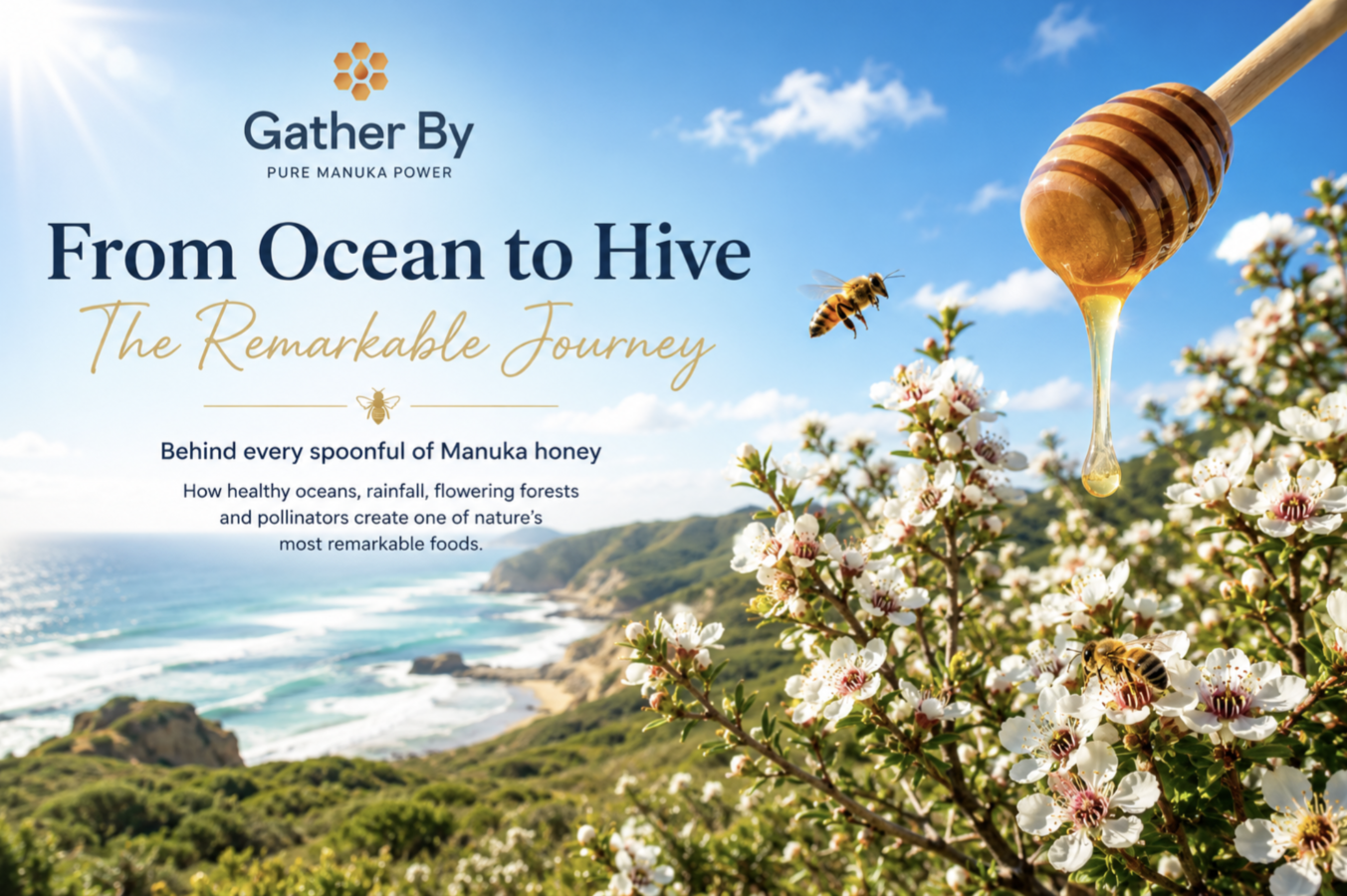
From Ocean to Hive: The Remarkable Journey Behind Every Spoonful of Manuka Honey
World Oceans Day Special
Discover how healthy oceans, rainfall, flowering forests and pollinators work together to create one of nature's most remarkable foods.
When most people think about honey, they think about bees.
When most people think about oceans, they think about beaches, waves and marine life.
Rarely do we think about the connection between the two.
Yet every spoonful of honey begins with a remarkable chain of environmental events stretching from the ocean to the hive.
This World Oceans Day, it's worth remembering that healthy ecosystems do not exist in isolation. The oceans, atmosphere, rainfall, soils, flowering plants, pollinators and food systems that sustain us are all connected.
And nowhere is that connection more visible than in a jar of premium Australian Manuka honey.
Life Begins With the Ocean
Covering more than 70% of the Earth's surface, the oceans are the foundation of life as we know it.
They regulate global temperatures, influence weather systems, drive rainfall patterns and support an extraordinary diversity of life.
Many people refer to forests as the lungs of the Earth, yet the oceans quietly perform an equally important role. Tiny marine organisms known as phytoplankton are estimated to produce around half of the oxygen we breathe.
The oceans also absorb vast amounts of carbon dioxide and heat, helping moderate the climate systems that make life on land possible.
Without healthy oceans, there would be no healthy landscapes, no healthy forests and ultimately no healthy food systems.
Australia's Extraordinary Coastline
Australia is an island continent with more than 34,000 kilometres of coastline.
From tropical Queensland and the Northern Territory to the rugged coastlines of Tasmania and Western Australia, our shores support an incredible diversity of ecosystems.
Mangroves, saltmarshes, coastal heathlands, dunes, wetlands and subtropical forests all play important roles in supporting biodiversity.
Here on Australia's east coast, many of our native flowering species thrive in environments shaped by ocean influences. Coastal winds, rainfall patterns, humidity and temperature all contribute to the health of these ecosystems.
Among them are some of Australia's most remarkable Leptospermum species — the flowering tea trees responsible for producing Manuka honey.
The Water Cycle That Powers Every Nectar Flow
One of the most important yet least understood aspects of honey production is the role of water.
Every strong nectar flow begins long before a bee visits a flower.
It begins in the ocean.
As sunlight warms the sea, water evaporates into the atmosphere. Clouds form and are carried across the landscape before returning as rain.
That rainfall replenishes rivers, wetlands and soils. It supports forests, flowering plants and the ecosystems that pollinators depend upon.
Without rainfall, there is no nectar.
Without nectar, there is no honey.
The process looks something like this:
Ocean
↓
Evaporation
↓
Cloud Formation
↓
Rainfall
↓
Healthy Soils
↓
Flowering Plants
↓
Nectar Production
↓
Pollinators
↓
Honey
It's a simple diagram, yet it tells an extraordinary story.
Every Spoonful Begins Long Before the Bee Arrives
When we think about honey, we naturally focus on the bee.
But every spoonful of honey begins long before a bee arrives at a flower.
For a Leptospermum tree to produce abundant nectar, many environmental conditions must align.
These include:
-
adequate rainfall
-
healthy soil moisture
-
sunlight
-
seasonal temperatures
-
pollinator activity
-
ecosystem health
A strong nectar flow is nature's way of telling us that many parts of the environment are working together.
Beekeepers often describe a season as being "good" or "poor," but those outcomes are usually the result of environmental conditions that have developed over months or even years.
Every jar of premium Manuka honey is ultimately the product of a healthy and functioning ecosystem.
Beyond its connection to healthy ecosystems, many people appreciate the various Manuka honey benefits, including its naturally occurring antibacterial properties, unique bioactive compounds and its role as a natural wellness food enjoyed around the world.
Australia's Remarkable Leptospermum Ecosystems
Australia is home to 87 recognised species of Leptospermum and around 15 varieties currently identified as producing highly active Manuka honey.
These species occur across an extraordinary range of environments, from coastal heathlands and subtropical forests to mountain regions and inland ecosystems.
Some of the most important varieties include:
-
Leptospermum polygalifolium
-
Leptospermum juniperinum
-
Leptospermum brachyandrum
-
Leptospermum whitei
-
Leptospermum liversidgei
-
Leptospermum scoparium
Each contributes its own unique flowering characteristics, nectar chemistry and ecological value.
This biodiversity is one of the reasons Australian Manuka honey has attracted growing international attention in recent years.
The diversity of Australian Leptospermum species helps create a broad range of nectar profiles and contributes to the production of some of the world's most potent Manuka honeys.
Why Healthy Ecosystems Create Better Honey
Healthy bees require more than nectar.
They need access to diverse pollen sources, clean water, suitable habitat and resilient ecosystems.
Just as humans benefit from a varied diet, bees thrive when they can access a wide range of flowering plants throughout the year.
Biodiversity helps support:
-
bee nutrition
-
colony strength
-
pollinator resilience
-
ecosystem health
-
sustainable honey production
The healthiest honey-producing landscapes are often those with the greatest ecological diversity.
Healthy ecosystems support healthy bees.
Healthy bees help sustain healthy ecosystems.
The relationship works both ways.
What Gather By Is Trying to Do
At Gather By, our focus extends beyond producing premium Manuka honey.
Through our Medicinal Honey Forest™ model, we are working to help create healthier ecosystems for pollinators, growers and local communities.
Our approach includes:
-
planting high-DHA Australian Leptospermum varieties
-
supporting flowering diversity
-
improving bee nutrition through fodder species
-
reducing the need for hive relocation
-
restoring degraded landscapes
-
working alongside growers and Traditional Owners
The goal is not simply to grow more trees.
It is to help create healthier, more resilient ecosystems that support pollinators and biodiversity long into the future.
Because exceptional honey begins with healthy landscapes.
Everything Is Connected
One of the most important lessons nature teaches us is that nothing exists in isolation.
The oceans influence the atmosphere.
The atmosphere influences rainfall.
Rainfall supports forests.
Forests support flowers.
Flowers support bees.
Bees support biodiversity and food systems.
And ultimately, those systems support us.
Every spoonful of Manuka honey tells that story.
Final Thoughts
World Oceans Day reminds us that healthy ecosystems are built upon countless connections, many of which we rarely see.
A jar of honey may appear simple, yet behind it lies an extraordinary journey.
A journey that begins in the ocean, travels through the atmosphere, nourishes flowering landscapes and ultimately reaches the hive.
The next time you enjoy a spoonful of Manuka honey, consider the remarkable chain of events that made it possible.
From ocean to hive, everything is connected.
Frequently Asked Questions
1] What does the ocean have to do with honey production?
Oceans drive evaporation and rainfall systems that support flowering plants, nectar production and ultimately honey production.
2] Why are healthy oceans important for ecosystems?
Healthy oceans help regulate climate, produce oxygen, influence rainfall and support biodiversity across both marine and terrestrial environments.
3] What is a nectar flow?
A nectar flow occurs when flowering plants produce abundant nectar, allowing bees to collect sufficient resources for honey production.
4] Why is rainfall important for honey production?
Rainfall supports plant growth, flowering and nectar production. Poor rainfall often results in reduced nectar flows and lower honey yields.
5] How many Leptospermum species are there in Australia?
Australia is home to 87 recognised Leptospermum species, with around 15 currently identified as producing highly active Manuka honey.
6] Why is biodiversity important for bees?
Diverse ecosystems provide bees with a broader range of pollen and nectar sources, supporting nutrition, resilience and colony health.
7] What is a Medicinal Honey Forest™?
Gather By's Medicinal Honey Forest™ model combines high-DHA Leptospermum species with supporting bee fodder plants to create healthier pollinator ecosystems.
8] Why is Australian Manuka honey unique?
Australia's remarkable Leptospermum diversity, unique environments and high-DHA species contribute to the production of highly active Manuka honey.
A Final Note from Gather By
At Gather By, we believe every jar of Manuka honey represents far more than a food product.
It represents healthy oceans, healthy landscapes, healthy plants and healthy pollinators working together in harmony.
The more we understand those connections, the better equipped we are to protect them for future generations.
We also offer wholesale supply options for retailers, distributors, health stores and businesses looking to source premium Australian Manuka honey.
If you'd like to learn more about our products, sustainability initiatives or wholesale opportunities, please get in touch with our team or contact us today!
Because healthy ecosystems create extraordinary outcomes.
And everything is connected.
Written by Matt Blomfield
Founder, Gather By Australian Manuka Honey


Efterlad en kommentar
Denne side er beskyttet af hCaptcha, og hCaptchas Politik om beskyttelse af persondata og Servicevilkår er gældende.