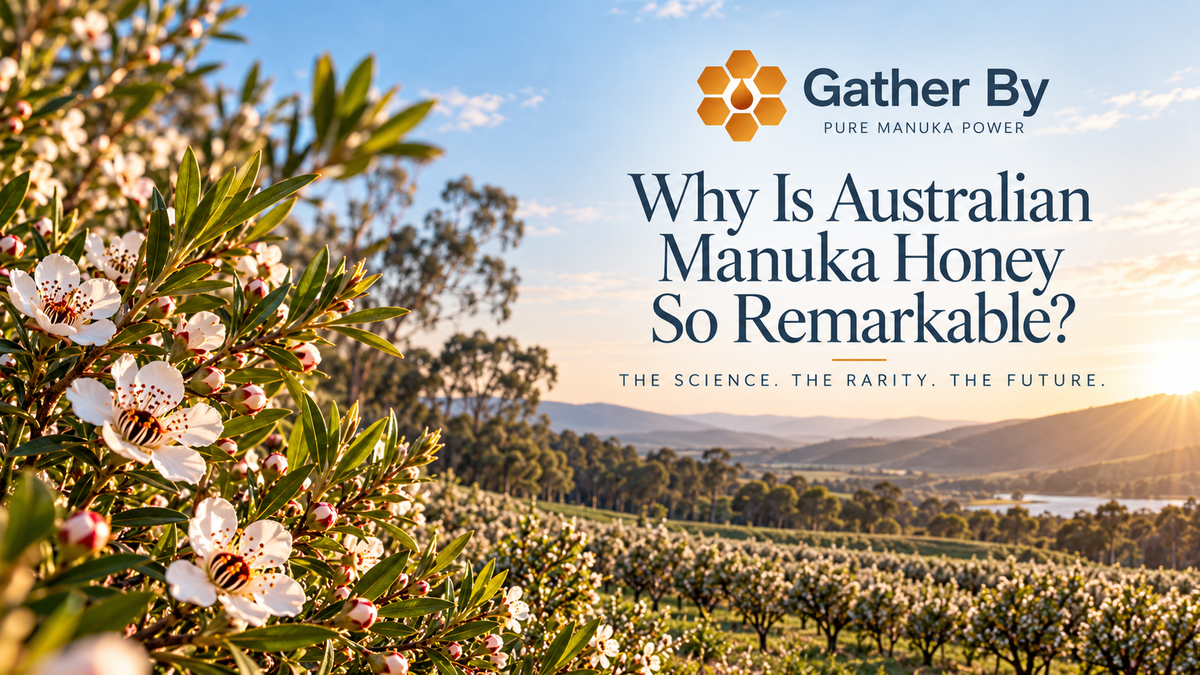
Why Is Australian Manuka Honey So Remarkable
The science, rarity and Australian vision behind one of nature's most extraordinary honeys.
Most people know honey as something sweet and delicious.
But Australian Manuka honey has a remarkable story.
Its distinctive properties begin with native Australian flowering plants, continue through the work of bees and develop through a natural chemical process that can take many months.
Some Australian Manuka honeys achieve exceptionally high concentrations of methylglyoxal (MGO), a naturally occurring compound associated with their distinctive antibacterial activity.
At Gather By, we've spent more than a decade researching these plants and developing a way to produce exceptional honey while creating new opportunities for Australian farmers, beekeepers, First Nations communities and regional Australia.
Our ambition is bigger than producing honey. We want to help build a regenerative Australian agribusiness industry.
Australia's Remarkable Native Manuka Plants
Australia is home to more than 80 native Manuka species historically classified within the genus Leptospermum.
These flowering plants belong to the Myrtaceae family, which also includes eucalyptus and Melaleuca.
Although sometimes called tea trees, Manuka plants are botanically distinct from Melaleuca alternifolia, the Australian plant best known for producing tea tree essential oil.
A botanical revision in 2023 also transferred many species previously classified as Leptospermum into related genera, including Leptospermopsis.
What hasn't changed is their extraordinary diversity.
Not all Australian Manuka plants produce nectar with the same chemistry.
Some contain very little dihydroxyacetone (DHA), while others produce exceptional concentrations of this natural precursor to MGO.
Scientific research has identified several important species, including:
-
Leptospermum polygalifolium, associated with exceptionally high-MGO Australian honey.
-
Leptospermum liversidgei, investigated for the antibacterial activity of its honey.
-
Leptospermum speciosum and Leptospermum whitei, identified as particularly high-DHA nectar producers.
These names reflect the published research, although some botanical classifications have since changed.
A 2018 Australian study investigating nectar from 55 species demonstrated substantial differences in DHA concentrations.
This is why selecting the right plants matters.
More Than a Decade of Research
Gather By's research partnership with the University of the Sunshine Coast has helped us understand the extraordinary potential of Australian Manuka.
Our research programme has examined 87 Australian Leptospermum species and related plant material, identified 15 high-activity varieties and selected five promising high-DHA clones for further development.
The objective is to move beyond relying entirely on naturally occurring Manuka stands.
By identifying exceptional plants, propagating them and establishing purpose-designed plantings, we aim to create a more reliable foundation for producing high-MGO honey.
This research underpins our Medicinal Honey Forest™ programme.
It's an investment measured in years, not months. Trees must be propagated, planted and established before their flowering and commercial potential can be realised.
What Makes MGO So Special?
The chemistry begins in the flower.
Certain Australian Manuka plants produce nectar containing DHA. Bees collect that nectar and transform it into honey.
Over time, DHA progressively converts into methylglyoxal, or MGO.
MGO is measured in milligrams per kilogram of honey.
An MGO300+ jar contains at least 300 mg/kg, while MGO900+ contains at least 900 mg/kg. Exceptional MGO2000+ honey contains at least 2,000 mg/kg.
These are measurable concentrations, not arbitrary marketing grades.
Australian research published in PLOS ONE demonstrated a strong relationship between MGO concentrations and non-peroxide antibacterial activity in laboratory testing.
Generally, higher MGO means greater MGO-associated antibacterial activity.
That doesn't mean a honey with twice the MGO necessarily provides twice the clinical benefit. Specific therapeutic applications require their own evidence.
But it does explain why MGO is such an important scientific measure of Manuka honey.
Beyond MGO — New Discoveries About Australian Honey
Australian honey science continues to reveal fascinating discoveries.
In September 2025, the University of the Sunshine Coast announced research using a rapid analytical method capable of testing for 109 phenolic compounds in honey.
Phenolics are naturally occurring plant-derived substances that contribute to the chemical characteristics of many foods.
More than half the compounds investigated were detected across the Australian honey samples examined.
The research offers new opportunities to understand botanical origins, investigate antioxidant properties and identify distinctive Australian honeys.
Phenolic analysis doesn't replace MGO testing, nor does laboratory antioxidant activity establish a clinical benefit.
But it reinforces something important: Australian honey is chemically diverse, and we're still discovering what makes different floral sources remarkable.
Spring Harvest — Why Exceptional Honey Takes Time
Spring is a busy period for our beekeepers and Medicinal Honey Forest™ growers.
As flowering conditions permit, bees collect nectar while beekeepers manage their colonies and harvest honey.
But harvesting isn't necessarily the end of the journey.
Fresh Australian Manuka honey may contain significant DHA that hasn't yet converted into MGO.
At Gather By, selected honey can be carefully stored for up to 18 months while its natural maturation progresses.
During that period, we monitor its development through independent laboratory testing.
The original nectar chemistry, storage conditions and time all influence the final MGO concentration.
And not every batch develops into ultra-high-MGO honey.
That's what makes exceptional honey so rare.
Why Is MGO2000+ Honey So Expensive?
Producing exceptionally high-MGO honey requires an unusual combination of circumstances.
The right plants must produce nectar with extraordinary DHA potential. Bees must successfully collect that nectar, and the resulting honey must be carefully harvested, matured and tested.
Even then, only a small proportion of production reaches the highest MGO concentrations.
At Gather By, we've independently tested exceptional batches exceeding MGO2300+.
Honey of this concentration is extraordinarily scarce.
Its price reflects that rarity, together with years of plant research, beekeeping, specialised production, storage, testing and the time between harvest and sale.
Higher-MGO honey contains a greater measured concentration of methylglyoxal, with associated differences in laboratory antibacterial activity.
It is not a guarantee of proportionately greater clinical outcomes.
For customers seeking the rarest expressions of Australian Manuka, however, these exceptional grades represent a remarkable natural product.
Independent Testing and the Role of AMHA
Premium Manuka honey deserves credible evidence behind its claims.
At Gather By, independent laboratory testing measures important compounds, particularly MGO and DHA, supporting accurate grading, traceability and quality assurance.
The Australian Manuka Honey Association (AMHA) also plays an important role in building confidence in Australian Manuka.
Its work includes scientific standards, industry representation, authentication, consumer education and protecting international recognition of Australian Manuka.
The AMHA's Mark of Authenticity provides a verification framework for appropriately licensed products.
Its classifications include Authorised, Authentic and Elite, with Elite beginning at MGO500+ and a minimum DHA requirement of 500 mg/kg under the association's published position.
The distinction between authentication and potency is important.
The AMHA Mark verifies compliance with defined standards. An individual honey's MGO rating measures its methylglyoxal concentration.
The Elite threshold doesn't represent the maximum potency Australian Manuka can achieve.
For consumers, independent testing and credible authentication help provide confidence in what they're buying.
Medicinal Honey Forest™ — Growing More Than Honey
Gather By's long-term vision is to establish productive Australian Manuka landscapes through our Medicinal Honey Forest™ programme.
Working with landholders, we propagate and plant selected high-performing Australian native Manuka varieties.
These plantings are designed to provide bee forage and support high-MGO honey production while creating opportunities for farmers to diversify their income.
For beekeepers, they offer the potential for more dependable flowering resources and longer-term grower partnerships.
For First Nations communities and regional Australia, we see opportunities in land partnerships, plant propagation, beekeeping, processing and commercial participation.
Appropriately designed native plantings can also contribute flowering habitat and opportunities for improved ecological function, although outcomes depend on site conditions and management.
Our model connects the entire value chain: research, propagation, planting, beekeeping, honey maturation, testing, packing and sales.
And it follows a simple principle.
The more honey we sell, the more trees we can plant.
Honey sales support the commercial foundations for future plantings. Those plantings create opportunities for growers and beekeepers, potentially producing more honey and supporting further reinvestment.
It's a developing circular business model intended to combine economic opportunity with environmental stewardship.
Our ambition is to help establish a new Australian regenerative agribusiness industry, not simply expand a honey brand.
Five Questions About Australian Manuka Honey
1. What does MGO measure?
Methylglyoxal concentration, expressed in milligrams per kilogram of honey. Higher MGO ratings indicate higher measured concentrations.
2. Why is ultra-high-MGO honey rare?
It requires exceptional nectar chemistry, suitable flowering and bee activity, and successful maturation. Only a small proportion of honey reaches these concentrations.
3. Does Manuka honey become stronger as it ages?
MGO can increase as DHA converts during maturation. However, the process depends on the honey and its storage conditions; MGO doesn't increase indefinitely.
4. What does the AMHA Mark mean?
It verifies that appropriately licensed products meet the association's defined authenticity and grading requirements. It is distinct from an individual honey's MGO rating.
5. What makes Gather By different?
Our integrated approach combines long-term plant research, selected propagation, grower and beekeeper partnerships, independent testing and the development of Medicinal Honey Forests™.
More Than Honey — An Australian Opportunity
This spring, as our beekeepers and growers work through another season, I'm reminded how much patience exceptional Australian Manuka demands.
Trees planted years earlier must flower. Bees must collect the right nectar. And the honey may need many more months to reach its potential.
There are no shortcuts to producing something truly exceptional.
At Gather By, we're proud of our honey, but equally excited by what we're helping to build around it.
New opportunities for farmers and First Nations communities. A stronger future for beekeepers. Productive native landscapes. And a scientifically credible Australian industry with the potential to produce some of the world's most extraordinary Manuka honey.
Because the real value of Australian Manuka isn't measured only by what's inside the jar.
It's also measured by what we can grow together.
Matt Blomfield
Founder, Gather By
PURE MANUKA POWER
Scientific references and further reading
-
Williams SD et al. (2018). Dihydroxyacetone Production in the Nectar of Australian Leptospermum Is Species Dependent. https://doi.org/10.1021/acs.jafc.8b04363
-
Cokcetin NN et al. (2016). The Antibacterial Activity of Australian Leptospermum Honey Correlates with Methylglyoxal Levels. https://doi.org/10.1371/journal.pone.0167780
-
University of the Sunshine Coast (2025). Sweet! New test finds seven potential Aussie 'health honeys'. https://www.unisc.edu.au/about/unisc-news/news-archive/2025/september/sweet-new-test-finds-seven-potential-aussie-health-honeys
-
Australian Manuka Honey Association. https://manukaaustralia.org.au/
-
Long-term stability and the physical and chemical factors predictive for antimicrobial activity in Australian honey (2024). https://pmc.ncbi.nlm.nih.gov/articles/PMC11111008/


Deixar comentário
Este site é protegido por hCaptcha e a Política de privacidade e os Termos de serviço do hCaptcha se aplicam.