
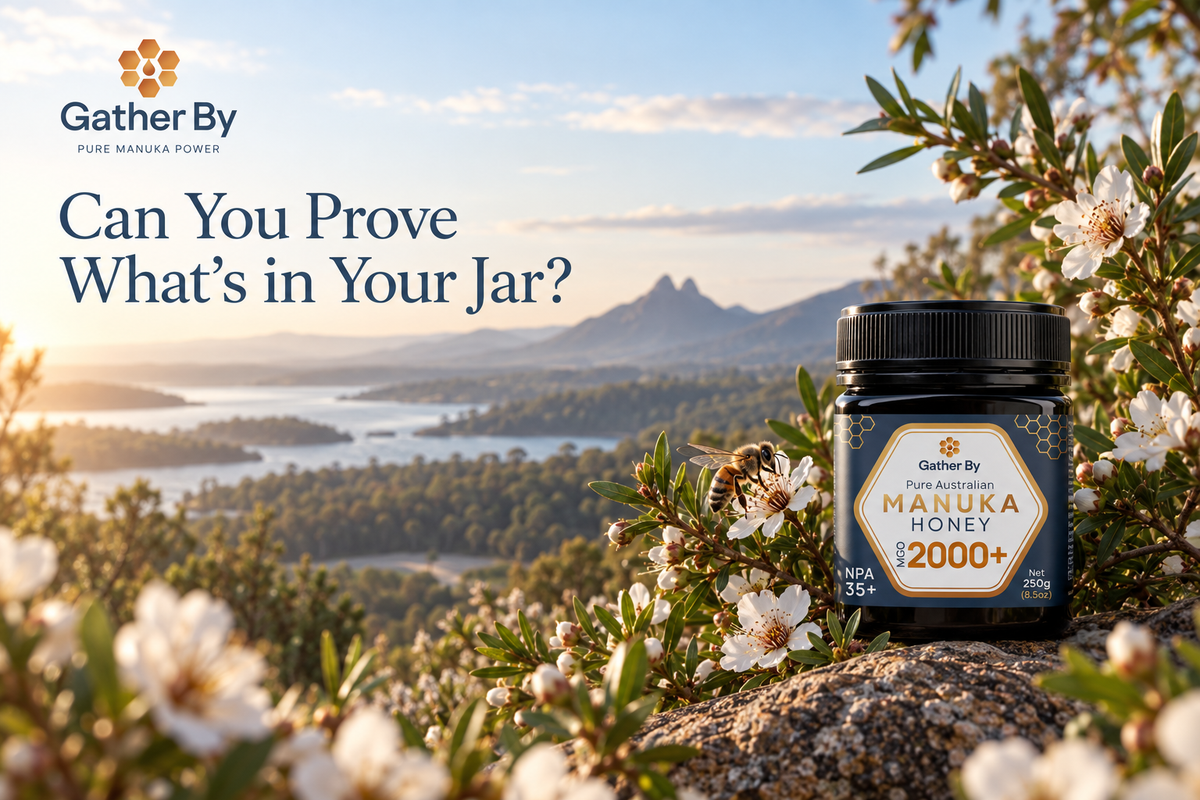
Flower to Home - Do you know what's in your jar?
Can You Prove What’s in Your Jar?
Why provenance, purity and authentication matter with Australian Manuka honey
September is Organic Awareness Month. It encourages us to think more carefully about where our food comes from, how it was produced and whether the claims on the label can be substantiated.
For Gather By, it raises an even bigger question:
How much do we really know about what is inside the jar?
With Australian Manuka honey, that matters. This is a natural food with measurable chemistry, significant scientific interest and, at higher MGO levels, considerable value.
Authenticity shouldn't begin with a claim on a label.
It should begin at the source.
Beyond an Organic Label
Organic certification has an important place in food production, but honey presents an unusual challenge: bees don't recognise fences.
They can forage kilometres from their hive across farms, bushland, waterways and conservation areas. A five-kilometre radius alone covers almost 79 square kilometres, or around 7,850 hectares. Even apparently pristine land may be subject to legitimate weed and pest-management programs.
Gather By does not sell its honey as certified organic or use an organic certification mark.
Our focus is on something different: knowing and preserving the identity of our Australian Manuka honey.
Where did it begin? Who produced it? What happened after harvest? What does independent testing tell us? And can we connect that evidence to the finished jar?
Awareness is about asking questions. Provenance is about being able to answer them.
Provenance Starts at the Beginning
Australian Manuka begins with Leptospermum flowers.
Certain Australian Leptospermum produce nectar containing dihydroxyacetone, or DHA. After bees turn that nectar into honey, DHA progressively contributes to the formation of methylglyoxal, or MGO — an important compound associated with Manuka honey's distinctive antibacterial activity.
Through our Medicinal Honey Forest™ program, Gather By knows where its selected Australian Manuka plants have been established and records key information about those plantings and their development.
The MHF program is also part of our approach to creating productive landscapes with environmental and commercial value. It is a developing source of Gather By honey, rather than our entire supply.
Our trusted Australian beekeepers remain fundamental.
They aren't anonymous commodity suppliers. We know them personally.
That matters because the beekeeper knows where the hives were placed, what was flowering, when the honey was harvested and how it was handled.
A laboratory can tell us a great deal about a sample.
It cannot recreate a history that nobody recorded.
What Happens After Harvest Matters
For most foods, harvest sounds like the end of the growing story.
With Manuka, something fascinating is still happening.
DHA continues to contribute to the formation of MGO as the honey matures. Research has demonstrated that time and temperature influence this process, including the efficiency of DHA-to-MGO conversion.
That means caring for Manuka after harvest matters.
At Gather By, some honey can be carefully stored and monitored under temperature-controlled conditions for up to 18 months as its natural maturation takes place. We then independently laboratory test our Manuka to understand what the honey has actually achieved.
This is an important part of provenance too. Knowing where honey came from isn't enough if you lose control of what happens next.
Know the honey. Look after it. Never lose its identity.
Why Honey Authenticity Matters
There is a reason we take that chain so seriously.
Honey authenticity can be surprisingly difficult to establish after the event.
Australia saw this publicly in 2018 when NMR testing led to allegations that some imported and blended supermarket honeys contained added sugar syrup. The ACCC investigated and concluded that the NMR method available at the time was not sufficiently reliable to support those allegations.
But the investigation revealed something equally important: the ACCC also reported low confidence in the existing C4 test used to detect adulterated honey and called for more robust testing to give consumers greater assurance about honey integrity.
The challenge remains relevant.
In late 2025, an Australian Government pilot sampled imported honey representing approximately 95% of Australian honey imports excluding New Zealand. All samples passed the existing mandated testing panel. Yet NMR profiling identified a number as suspected of containing foreign sugars. That does not prove adulteration, but the differing results demonstrate how technically difficult honey authentication can be.
There is a powerful lesson in that.
Rather than relying solely on trying to reconstruct a honey's history at the end, establish provenance from the beginning and maintain it.
More Than an MGO Number
With Manuka, authenticity carries additional significance because the honey has attracted substantial scientific and medical interest internationally.
MGO stands for methylglyoxal and is measured in milligrams per kilogram.
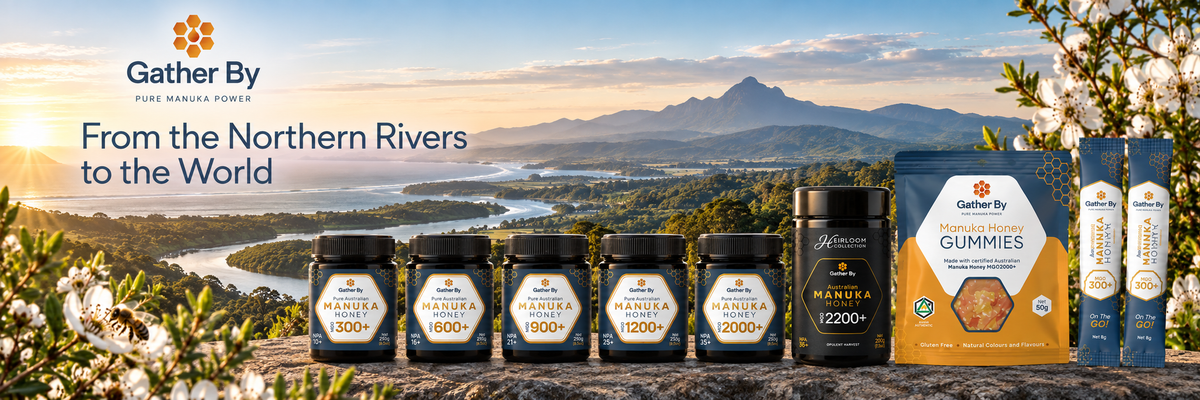
MGO300+ means at least 300 mg/kg. MGO900+ means at least 900 mg/kg. MGO2000+ means at least 2,000 mg/kg.
But printing a number on a jar doesn't prove it.
Measurement does.
Gather By independently laboratory tests its Manuka honey, with Certificates of Analysis and records supporting the MGO strength attributed to each relevant batch.
And the science of Australian Manuka authentication is continuing to develop.
Australian Manuka scientists are developing more advanced approaches to authentication, using multiple naturally occurring chemical markers to build a richer picture of genuine Australian Manuka.
The science is still developing, but the direction is significant: authentication isn't only about detecting what shouldn't be in honey. It is increasingly about understanding the natural chemical signature of what should be there.
Authentication isn't only about detecting something that shouldn't be in honey. Increasingly, science can also help identify what should be there.
MGO tells us something important about potency. A broader chemical profile can tell us more about identity. Provenance tells us where it came from.
No single number needs to carry the whole story.
From Batch Number to Provenance Passport
One of the least glamorous things printed on a Gather By jar may be one of the most important: its batch number.
Behind that number sits a much larger body of information connecting source and provenance, laboratory testing and Certificates of Analysis, storage and maturation, production and packing, and ultimately the finished jar.
The batch number is the thread connecting those records.
Gather By is also a member of the Australian Manuka Honey Association, whose work around Australian origin, science, testing and authenticity contributes to confidence in the Australian Manuka category. Gather By operates within HACCP and B-QUAL systems, holds Halal certification and maintains the registrations and compliance required for the markets in which we sell.
But trust isn't created by putting more logos on a label.
It comes from being able to substantiate what the label says.
That's also why Gather By already uses secure QR technology to authenticate our Manuka honey and is expanding that capability into a richer digital provenance passport.
The technology doesn't create provenance. The provenance has to exist first.
The aim is to connect more of the evidence already behind the jar — authentication, batch information, independent laboratory testing and provenance — with the person holding it.
That's particularly important for Gather By, which has been selling Australian Manuka internationally longer than it has nationally in Australia. Today, our honey travels thousands of kilometres from the Australian landscape and beekeeper that produced it.
Distance shouldn't diminish confidence in what's inside.
Five Questions About Australian Manuka Honey
1. What is Australian Manuka honey?
Australian Manuka honey is produced from nectar collected from certain Australian Leptospermum species, some of which naturally produce nectar containing high levels of DHA.
2. What does MGO mean?
MGO stands for methylglyoxal, an important compound associated with Manuka honey's antibacterial activity. An MGO rating with a + indicates a minimum measured concentration in milligrams per kilogram.
3. How can you tell if Manuka honey is authentic?
There is no single answer. Provenance, independent laboratory testing, characteristic chemistry, batch traceability and secure authentication can all provide evidence about a honey's identity.
4. Is Gather By Manuka honey organic?
Gather By does not market its honey as certified organic or use an organic certification mark. Our focus is on provenance, independent testing, traceability and being able to substantiate what we say about our honey.
5. What is a Manuka honey provenance passport?
For Gather By, it is the evolution of our existing secure QR authentication into a richer connection between the physical jar and the evidence behind it — progressively bringing authentication, batch, testing and provenance information closer to the customer.
The Question We Keep Coming Back To
Organic Awareness Month started this conversation, but the bigger subject is trust.
Know the landscape. Know the plants. Know the beekeeper. Know the honey. Care for it as it matures. Test what can be measured. Keep the records connected to the batch. Then give the person buying the jar a way to authenticate what they are holding.
Because provenance isn't a story created when the marketing begins.
It is an unbroken chain of knowledge from the beginning.
Matt Blomfield
Founder & CEO
Gather By
PURE MANUKA POWER

Deixar comentário
Este site é protegido por hCaptcha e a Política de privacidade e os Termos de serviço do hCaptcha se aplicam.