
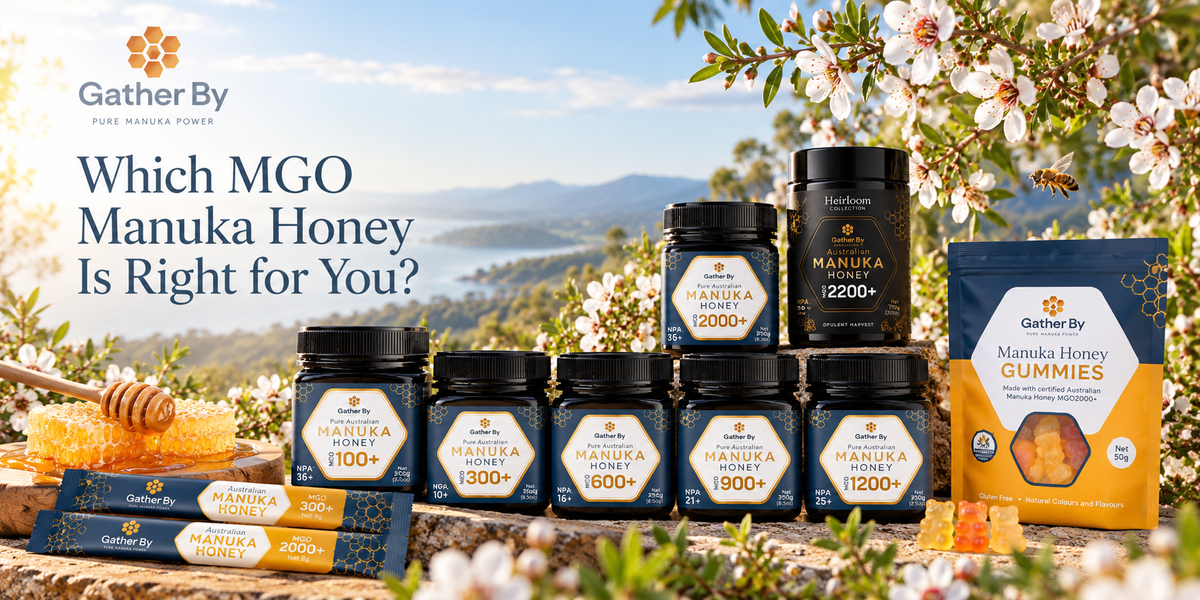
Which MGO Manuka Honey Is Right for You?
From everyday MGO100+ to rare MGO2200+, understanding what the numbers mean — and how to choose the Australian Manuka that makes sense for you
Walk into the world of Manuka honey and it doesn't take long before the numbers appear.
MGO100+. MGO300+. MGO600+. MGO900+. MGO1200+. MGO2000+. MGO2200+.
Understandably, one of the questions we hear most often is:
Which one do I need?
Our Sales & Customer Support Manager, Julie Hollonds, has had more than 10,000 conversations with Gather By customers. One question sits behind many of them: which MGO should I choose?
The answer starts with understanding what is actually being measured.
What Does MGO Mean?
MGO stands for methylglyoxal, one of the important compounds contributing to Manuka honey's distinctive non-peroxide antibacterial activity.
It is measured in milligrams per kilogram.
MGO300+ means the honey has been tested to contain at least 300 mg/kg of methylglyoxal. MGO600+ means at least 600 mg/kg. MGO2000+ means at least 2,000 mg/kg.
The + matters. It means minimum.
Research into Australian Leptospermum honey has demonstrated a strong relationship between MGO concentration and non-peroxide antibacterial activity.
That's why Gather By puts MGO front and centre on our jars. We believe one of the most important measurements should also be one of the easiest for customers to understand.
But choosing the right Manuka involves more than finding the biggest number.
Does Higher MGO Always Mean Better?
Someone wanting Australian Manuka as part of everyday life has a different requirement from someone deliberately seeking exceptionally high-MGO honey.
That's why we think of the Gather By range in four broad collections.
Everyday — MGO100+ and MGO300+
These are our accessible everyday Australian Manuka honeys.
They can be enjoyed straight from the spoon, with food or as part of an everyday routine.
For someone discovering Australian Manuka for the first time, this is a natural place to begin.
Restorative — MGO600+ and MGO900+
This is a substantial step up in measured MGO activity.
If budget meant we could keep only one jar of Gather By Manuka in the cupboard, our choice would be MGO600+ 500g.
At $129, a 500g jar provides approximately 100 × 5g serves. That's $1.29 per serve.
Australian research has established a strong relationship between MGO concentration and non-peroxide antibacterial activity, which is why this part of the MGO spectrum is particularly interesting.
For us, MGO600+ occupies an important place in the range: substantially higher measured MGO while still practical enough for regular use.
MGO900+ takes the concentration higher again for customers deliberately seeking a stronger Manuka.
Platinum — MGO1200+ and MGO2000+
At these levels, we're moving into exceptional Australian Manuka.
And increasingly, rarity matters.
You cannot simply manufacture more naturally high-MGO honey because customers want it. The right Leptospermum nectar, bees, season and environmental conditions have to come together. After harvest, Manuka's chemistry continues to develop as the honey matures.
Ultimately, independent laboratory testing tells us what nature has produced.
Many customers don't consume very high-MGO Manuka like ordinary table honey either. They keep a jar on hand and use small amounts at a time, so one jar may last for months.
That can put the purchase price into a very different perspective.
Heirloom — MGO2200+
At MGO2200+, we're talking about extraordinarily rare Australian Manuka.
Very little honey naturally reaches these concentrations.
At this level, you're not simply choosing greater measured MGO. Rarity, provenance and the experience of owning or gifting something exceptional all become part of its value.
What Are People Actually Using Manuka For?
More than 10,000 customer conversations have given us an unusual insight into why people seek out Australian Manuka.
Five subjects come up particularly often with Julie: gut health, skin conditions, wound care, inflammation and coughs.
There are also regular questions about oral health, throat comfort and incorporating Manuka into everyday life.
Customer interest and scientific evidence, however, aren't the same thing. Research is considerably stronger in some areas than others.
Wound care has one of Manuka's most substantial bodies of scientific and clinical research, including antibacterial and antibiofilm properties and its use in wound management. Importantly, clinical wound care generally uses specially prepared medical-grade honey products rather than ordinary food honey.
Oral health is another interesting area. Human research has investigated Manuka in relation to dental plaque and gingival health, including studies reporting reductions in plaque and gingival bleeding.
For coughs and throat comfort, there is good evidence around honey generally. A systematic review and meta-analysis found honey improved cough frequency and severity and combined symptoms of upper respiratory tract infections compared with usual care. That evidence relates to honey broadly rather than establishing that a particular MGO strength is required.
Gut health is one of the subjects our customers ask about most frequently and an area attracting continuing scientific interest. The clinical evidence is less established, however, and research continues.
Inflammation also appears in Manuka research, particularly in wound biology, but that is different from claiming that eating Manuka honey treats an inflammatory condition.
There is fascinating science around Manuka, but an MGO chart shouldn't become a prescription chart where one condition is assigned MGO300 and another MGO1200.
Choosing Manuka is more nuanced than that.
Jars, Sticks or Gummies — Make Manuka Work for You
There doesn't need to be a complicated ritual around Manuka.
Gather By Australian Manuka comes in different formats for different routines — traditional jars, convenient honey sticks for Manuka on the go, and Australian Manuka honey gummies.
Some people enjoy a spoonful from the jar in the morning or with food. Others carry honey sticks when travelling, hiking, heading to work or packing the kids' lunchboxes. Some prefer the convenience of gummies.
Our gummies are made with MGO2000+ Australian Manuka honey, and testing of the finished product has shown approximately MGO150+ per two-gummy serve.
The important thing is finding the strength, format and routine that makes sense for you.
Why Does Higher-MGO Manuka Cost More?
A jar of MGO1200+, MGO2000+ or MGO2200+ can initially look expensive compared with ordinary honey.
But it's not really an equivalent comparison.
Exceptional high-MGO Australian Manuka is naturally scarce. And because many people use their highest-MGO honey sparingly, the price of the jar isn't necessarily the most useful measure of value.
A better question might be: what am I buying, how much will I actually use and how long will the jar last?
Our MGO600+ 500g illustrates the point. Around 100 × 5g serves for $129 works out at approximately $1.29 each.
Sometimes looking beyond the price on the jar changes the picture considerably.
Can You Trust the Number on the Jar?
Choosing an MGO only means something if you can trust the number.
Printing MGO2000+ on a label doesn't prove the honey inside contains it.
Measurement does.
Gather By places MGO front and centre on our branding so customers can quickly understand one of the most important measurements of the Manuka they're buying.
We also display NPA, or Non-Peroxide Activity, another expression of Manuka's antibacterial activity. Consumers familiar with New Zealand Manuka may recognise a similar numerical activity scale through UMF, although UMF itself is a separate New Zealand certification and trademark system.
Our Manuka is independently laboratory tested, with Certificates of Analysis and testing records connected to relevant batches.
Gather By is also a member of the Australian Manuka Honey Association. AMHA's work around Australian origin, science, testing, authenticity and quality marks plays an important role in strengthening confidence in Australian Manuka.
Batch identification, tamper-evident packaging and secure QR authentication add further layers of security. We're also expanding our existing QR capability into a richer digital provenance passport, progressively connecting more of the evidence behind the honey with the person holding the jar.
The objective is simple: customers should be able to trust that what's inside corresponds with what's stated on the label.
Honey Has Always Been More Than Food
There is another reason people choose Manuka that has little to do with comparing numbers.
Honey makes a wonderful gift.
For thousands of years, humans have valued honey as more than something sweet. It has appeared in traditions, celebrations and expressions of care across cultures.
Even the word honeymoon has associated honey with the sweetness of newly married life for centuries.
Perhaps that helps explain why giving someone an exceptional jar of Australian Manuka feels different from giving them an ordinary food product.
It can represent care. Something natural. Something rare. Something worth keeping.
And as we move through Platinum MGO1200+ and MGO2000+ to Heirloom MGO2200+, gifting becomes another reason for choosing something exceptional.
FAQ Five Questions About Choosing MGO Manuka Honey
Is higher MGO always better?
Higher MGO means a higher measured concentration of methylglyoxal. It doesn't mean everybody needs the highest MGO. How you intend to use your Manuka, how often you'll use it and your budget all matter.
What MGO should I choose for everyday use?
Gather By's Everyday Collection includes MGO100+ and MGO300+. For customers looking for substantially higher measured MGO, our Restorative Collection begins at MGO600+.
If I could buy only one Gather By Manuka, which would you recommend?
Our choice would be MGO600+ 500g. It offers a balance of substantially higher MGO, everyday practicality and value.
Why are MGO2000+ and MGO2200+ more expensive?
Australian Manuka at these exceptional MGO levels is extremely rare. Very little honey naturally reaches these concentrations, making supply inherently limited.
How do I know the MGO rating is genuine?
Look beyond the number on the jar. Independent laboratory testing, Certificates of Analysis, batch traceability, provenance and secure authentication all help substantiate what the label says.
The Right Jar Is the One That Makes Sense for You
Choosing Australian Manuka shouldn't simply be a race to the highest number.
MGO100+ and MGO300+ have an important place in everyday life. MGO600+ and MGO900+ form our Restorative range. MGO1200+ and MGO2000+ represent increasingly exceptional concentrations. And by MGO2200+, rarity itself becomes part of what makes the honey remarkable.
Whatever MGO you choose, the same principles matter: understand the number, know where your honey comes from, make sure the label can be substantiated, and choose the strength and format that make sense for you.
Matt Blomfield
Founder & CEO
Gather By
PURE MANUKA POWER

Laisser un commentaire
Ce site est protégé par hCaptcha, et la Politique de confidentialité et les Conditions de service de hCaptcha s’appliquent.