
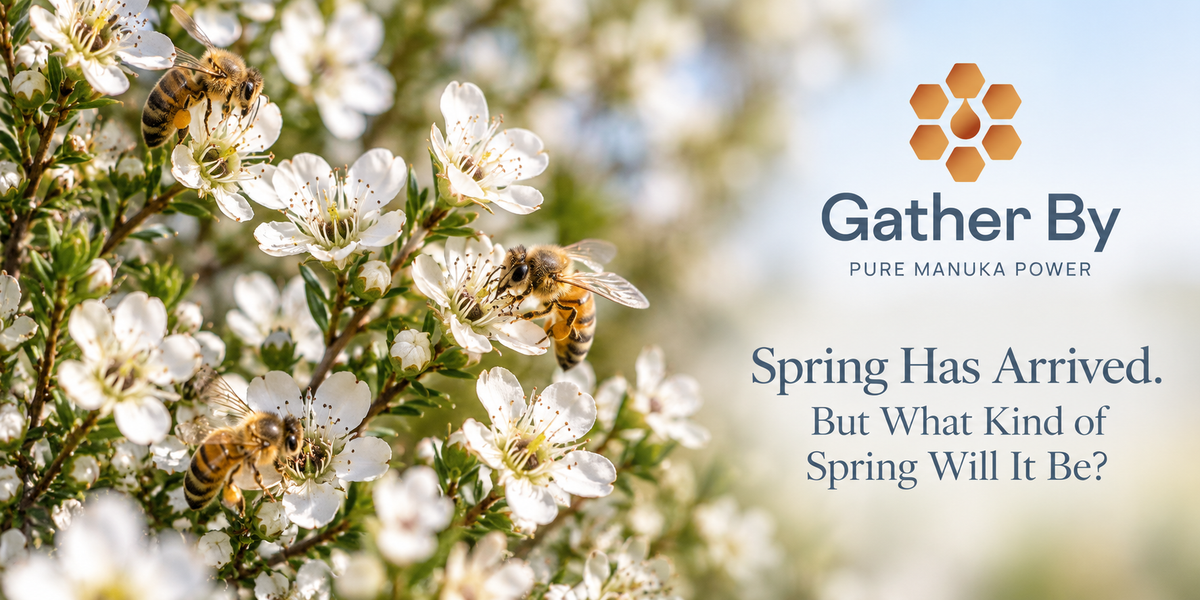
Spring Has Arrived. But What Kind of Spring Will It Be?
From blossoms and bees to a changing climate and Australian Manuka - why spring is a season of renewal, observation and change.
There is something unmistakable about spring in Australia.
The mornings become lighter. Blossoms appear. Cricket starts creeping back into conversation and, particularly across the southern states, that first genuinely warm spring day feels wonderful.
While much of the Northern Hemisphere is preparing for autumn, we're heading in the opposite direction.
Spring is our season of renewal.
But nature doesn't know the calendar clicked over to 1 September.
Plants respond to temperature, rainfall, soil moisture and daylight. Bees respond to flowering, nectar, pollen and weather.
For those of us working closely with bees and flowering landscapes, spring is a reminder that nature operates according to its own timetable.
And this year, we're watching particularly closely.
What Does Spring Mean to a Beekeeper?
matt
For Gather By, that's when regular observation becomes critical.
Our selected Australian Leptospermum varieties don't all flower together. Some flower earlier; others follow through the season. We need to understand which varieties are flowering, how strongly the bees are working them and when the honey should be harvested.
Take it too early and we may interrupt a strong flow. Leave it too long and another flowering source may begin contributing to what the bees collect.
Exceptional Manuka begins with the flower — but timing matters.
The Honey Isn't Finished When It Leaves the Hive
This is perhaps one of the least understood things about high-MGO Australian Manuka honey.
After bees collect the nectar and transform it into honey, DHA progressively gives rise to methylglyoxal — MGO as the honey matures.
MGO is strongly associated with the distinctive non-peroxide antibacterial activity of active Leptospermum honeys.
But freshly harvested high-potential Manuka can contain significantly more DHA than MGO.
So the MGO level when we harvest doesn't necessarily tell us where that honey may ultimately go.
Much of its potential can still be ahead of it.
That's why the journey isn't simply:
Flower → Bee → Honey → Jar.
It's:
Flower → Bee → Honey → Testing → Maturation → Testing → Jar.
Why Can Exceptional Manuka Take Around 18 Months?
For selected high-potential honey, patience becomes part of the process.
Some of our honey can spend around 18 months maturing under carefully controlled temperature conditions while we monitor its development towards the MGO potency we're seeking.
Temperature matters. Very cold storage can dramatically slow the conversion process. Too much heat isn't the answer either.
Working with high-potential Manuka is about understanding time, temperature and the natural chemistry already within the honey.
We don't simply try to make that process happen as quickly as possible. We want the honey to develop exceptional MGO potency while retaining its natural characteristics and remaining DHA.
Subject to time and storage conditions, the relationship between DHA and MGO can continue to evolve after bottling.
There's something wonderfully contrary about that in today's world of faster production, faster delivery and instant results.
Some of the most exceptional honey we produce asks something different of us.
Don't rush it. Understand it. Work with its timing.
What Does Spring Look Like to a Bee?
Bees experience our landscapes differently from us.
A large agricultural crop in flower can provide an extraordinary abundance of food for a period. But for bees, what flowers before and afterwards matters too.
A more botanically diverse landscape can offer different nectar and pollen resources at different times.
This isn't about portraying productive agriculture as the enemy of bees. Many Australian agricultural industries depend upon pollinators.
The more interesting question is:
Can productive agricultural landscapes also become better flowering landscapes?
That question sits behind much of our work with the Medicinal Honey Forest™.
Our approach includes selected Leptospermum varieties with early, middle and later flowering periods, within broader landscapes containing other vegetation and habitat.
Instead of thinking about one flowering event, think about a flowering sequence.
Different plants. Different timing. More opportunities for bees. Greater botanical diversity. And the potential to produce exceptional Australian Manuka alongside those environmental outcomes.
Spring is when that thinking becomes visible.
The flowers open — and the bees arrive.
But What Kind of Spring Are We Entering?
Spring 2026 has another dimension.
Australia is experiencing El Niño conditions, which can increase the likelihood of warmer and drier conditions across parts of eastern and southern Australia, although conditions vary enormously across the continent.
The Bureau of Meteorology's current spring outlook points towards warmer-than-average conditions across much of Australia, with rainfall patterns differing considerably between regions.
And behind individual seasons is a longer-term change.
Australia's climate has warmed by around 1.5°C since 1910. That's an Australian measurement and shouldn't be confused directly with the global 1.5°C threshold discussed in international climate agreements.
For those working with plants and bees, however, changing conditions aren't simply numbers in a report.
We see them through flowering.
When does it begin?
How long does it last?
Does rain arrive when plants need it?
Does extreme heat shorten flowering?
Is nectar flowing?
How do the bees respond?
Nature gives us feedback remarkably quickly when we're prepared to pay attention.
Spring Renewal Isn't About Starting Again
Perhaps that's why spring renewal resonates so strongly.
We talk about spring as though nature starts again.
But it doesn't.
The tree flowering today didn't suddenly appear in September. Its roots were there throughout winter. Its buds were developing before we noticed them. Rain that fell months ago may have helped determine what we're seeing now.
Spring isn't starting from nothing.
It's new growth emerging from everything that came before.
Perhaps there's something useful in that for us too.
Spring is when many of us get outside again, return to gardens, walk more, reconsider what we're eating and make plans for the warmer months.
Renewal doesn't require reinventing ourselves.
It can simply mean paying attention again.
To our health.
To the people we love.
To what we eat.
To the environment around us.
And to the things that may have changed while we weren't looking.
FAQ’s
1. What is a nectar flow?
A nectar flow occurs when flowering plants are producing enough nectar for bees to collect it intensively. Its timing and strength depend on plant species, weather and environmental conditions.
2. Why is spring important for honey bees?
Increasing temperatures and flowering can give colonies greater access to nectar and pollen, although timing varies considerably across Australia's different regions.
3. What is DHA and how does it become MGO?
DHA occurs naturally in the nectar of certain Australian Leptospermum species. After bees transform that nectar into honey, DHA progressively gives rise to MGO during maturation. Time and temperature influence the process.
4. Does MGO continue to develop after Manuka honey is bottled?
It can. Where DHA remains, the relationship between DHA and MGO can continue to change over time, influenced particularly by temperature and storage conditions.
5. Why does flowering diversity matter to bees?
Different plants flowering at different times can provide nectar and pollen resources across a longer period. That's why we're interested not only in what's flowering today, but what flowered before it and what will flower next.
What Will This Spring Bring?
We don't know.
And perhaps that's part of what makes working with nature so interesting.
Right now, across several landscapes we work with, flowers are opening and bees are working the nectar flow.
Over the coming weeks, beekeepers will watch their hives. Farmers will watch the sky. We'll inspect flowering, monitor honey and decide when the time is right to harvest.
Some of that honey may then begin another journey lasting around 18 months before we believe it's ready to release.
Nothing about it is instant.
Spring has always represented possibility.
But perhaps this year it also asks something of us.
Pay attention.
To the weather.
To the flowers.
To the bees.
To the landscapes that produce our food.
To the people we love.
And perhaps to ourselves.
Because renewal doesn't mean pretending nothing has changed.
It means understanding what has changed — and deciding what we do next.
Matt Blomfield
Founder & CEO, Gather By
PURE MANUKA POWER


Jätä kommentti
Tämä sivu on suojattu hCaptcha-tunnistuksella, ja hCaptchan tietosuojakäytäntöjä ja käyttöehtoja sovelletaan.