
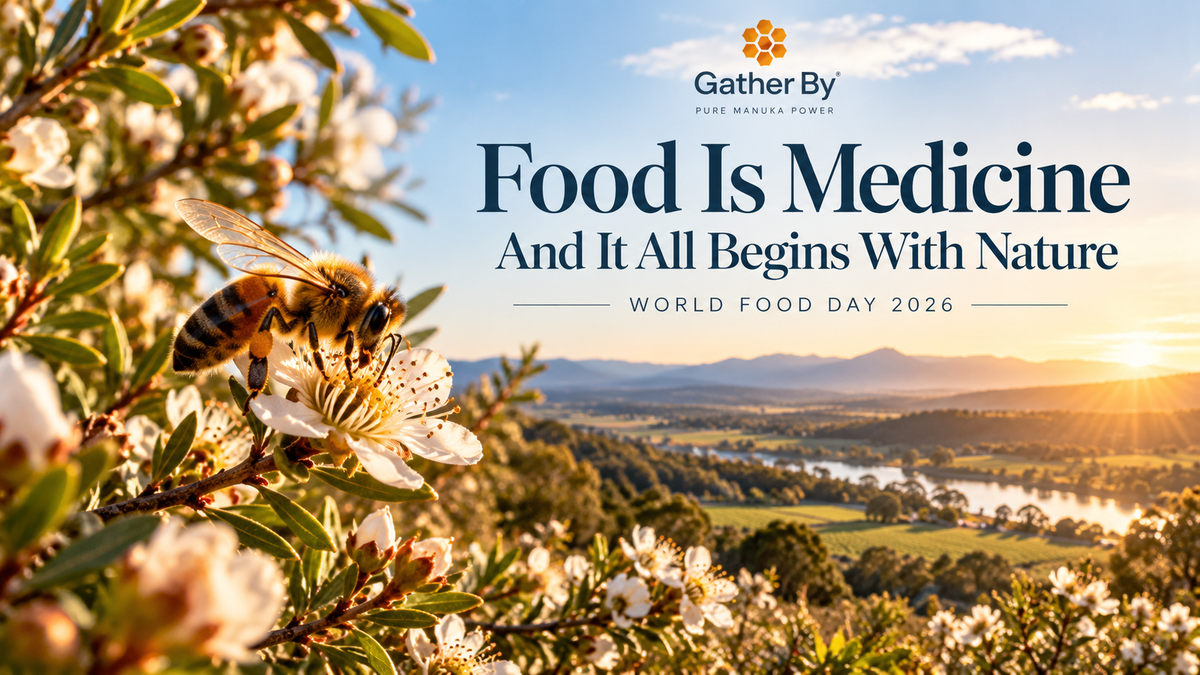
Food Is Medicine — And It All Begins With Nature
World Food Day 2026 | How nutrition, bees, pollination and Australian Manuka connect our health with the future of food.
Every day, we make decisions about what to eat.
Some are deliberate. Others happen between work, family commitments and everything else life demands.
But behind every meal lies an extraordinary story involving soil, sunlight, plants, farmers, pollinators and the natural systems that sustain us.
Today, 16 October, is World Food Day — an opportunity to think about something fundamental to our health and future.
Food is more than fuel. It influences how we feel, how well our bodies function and our long-term health.
And before food can nourish us, nature must first help produce it.
Food Is Medicine — What Does Science Tell Us?
The idea that food influences health is hardly new. What's changing is how much scientists are discovering about the relationships between nutrition, inflammation, immunity, metabolism and our gut microbiome.
Research consistently associates dietary patterns rich in vegetables, fruits, wholegrains, legumes, nuts and other minimally processed foods with better long-term health.
Australian researcher Professor Felice Jacka has also helped establish nutritional psychiatry, investigating how dietary quality relates to mental wellbeing.
The important lesson is that no single food provides everything our bodies need.
Good health is supported by the overall quality and variety of what we eat, together with physical activity, sleep and appropriate healthcare.
Food cannot replace every medicine. But nutrition is an important part of preventing disease, supporting recovery and maintaining our capacity to live well.
And sometimes improving our diet begins with remarkably simple choices.
Honey or Refined Sugar — Making a Better Choice
Most of us enjoy something sweet.
The question is how to enjoy it thoughtfully.
Refined table sugar provides sweetness and energy, but little else nutritionally.
Honey is different. Alongside its natural sugars, it contains water and smaller quantities of other naturally occurring compounds.
Australian Manuka honey is especially interesting because it contains methylglyoxal, or MGO, associated with its distinctive non-peroxide antibacterial activity.
Australian research has demonstrated significant antibacterial activity in selected Leptospermum honeys, helping explain the scientific interest in this remarkable native resource.
Research involving honey more broadly has also identified benefits for relieving some cough symptoms associated with upper respiratory tract infections.
These findings don't mean every spoonful of honey produces a particular medical outcome, but they do distinguish honey research from the study of ordinary refined sugar.
There's an important nutritional point, too: honey still contains free sugars. Replacing sugar with honey doesn't automatically reduce calories or improve blood glucose control.
A sensible approach is to use modest amounts of honey where you might otherwise use refined sugar, while reducing overall added sweetness.
Try a little Australian Manuka with natural yoghurt, porridge, fruit or wholegrain toast.
Better still, build the meal around nutritious whole foods and enjoy the honey as a complement.
The aim isn't simply to replace one sweetener with another. It's to make better food choices overall.
The Remarkable Contribution of Bees
Here's something worth remembering the next time you walk through a supermarket.
Approximately 35% of global crop production by volume comes from crops that depend, at least partly, on animal pollination.
And around 75% of the world's food crop types benefit to some extent from pollinators.
Bees are among the most important contributors, alongside butterflies, moths, flies, beetles, birds and other pollinating animals.
Think about apples, almonds, berries, pumpkins, melons and many other foods that bring variety and nutrition to our diets.
Some crops depend heavily on pollinators. Others benefit through improved yields, quality or consistency.
This doesn't mean bees produce one-third of everything we eat. Staple crops such as wheat and rice don't depend on insect pollination in the same way.
But it does mean that pollinators make an extraordinary contribution to the diversity and nutritional quality of our food supply.
Without them, our diets and agricultural systems would look very different.
Why Australia's Native Pollinators Matter
Australia is home to an extraordinary diversity of native bees and other pollinating insects.
Honeybees play an important role in agricultural pollination and honey production, but they're only part of the picture.
Native bees have evolved relationships with Australian plants, and some can pollinate flowers in ways honeybees cannot.
Different pollinators visit different plants, work under different conditions and contribute to the resilience of natural ecosystems.
Protecting flowering habitat, reducing unnecessary pesticide exposure and supporting diverse vegetation can help provide the resources pollinators need.
It's a reminder that productive agriculture and healthy natural environments aren't necessarily competing interests.
With thoughtful management, they can support one another.
Our Medicinal Honey Forest™ — A Different Way of Thinking About Honey Production
At Gather By, we've spent more than a decade researching Australian Leptospermum — the flowering native plants responsible for producing Australian Manuka honey.
Our Medicinal Honey Forest™ programme brings that research into the landscape.
Rather than relying entirely on naturally occurring flowering stands, we're working with Australian landholders to establish selected Leptospermum varieties chosen for their nectar characteristics and flowering periods.
The aim is to create productive Manuka landscapes capable of supporting high-MGO honey production while providing a more reliable forage environment for bees.
By combining early-, mid- and late-flowering varieties, we're working towards longer flowering opportunities that may help beekeepers maintain colonies on or near these sites.
That's important because bees need more than a brief flowering event. They need suitable forage, water, healthy colonies and responsible management throughout the year.
Our vision is sustainable, in-situ beekeeping, with productive landscapes that create value for growers and beekeepers.
And the potential benefits extend beyond the honey itself.
Bees Don't Recognise Property Boundaries
A honeybee doesn't stop for a fence.
When conditions and flowering patterns allow, bees forage across the surrounding landscape, visiting flowering plants within their flight range.
That creates an interesting opportunity for our Medicinal Honey Forest™ sites.
While bees collect nectar from Leptospermum to produce Australian Manuka honey, they may also visit nearby orchards, crops, gardens and native vegetation.
In suitable circumstances, that activity can provide pollination services to neighbouring properties without those landholders having to pay separately for contracted pollination.
It's a potential additional benefit of establishing productive flowering landscapes.
Of course, the actual outcome depends on local crops, flowering overlap, bee numbers, habitat and management. Pollination improvements need to be measured rather than assumed.
But the underlying principle is powerful.
A landscape designed to produce remarkable honey may also help support the production of other food around it.
That's the kind of thinking we believe deserves greater attention.
Food Security Begins With Healthy Landscapes
World Food Day isn't only about what we eat today.
It's about ensuring future generations have access to nutritious food.
That means supporting farmers and growers, protecting productive land, maintaining healthy ecosystems and recognising the extraordinary contribution of pollinators.
It also means developing agricultural systems that are economically viable.
Through our Medicinal Honey Forest™ programme, we're working to connect Australian landholders, beekeepers and honey production in ways that create opportunities for regional communities.
The more successful this model becomes, the greater the opportunity to establish additional Manuka plantings.
It's a long-term undertaking, but one grounded in a simple idea: productive agriculture can create value while supporting the natural systems on which it depends.
Five Everyday Choices That Matter
We don't all manage farms or keep bees. But we can make choices that contribute to our health and the wider food system.
-
Choose more whole foods. Build meals around vegetables, fruit, wholegrains and other nutritious ingredients.
-
Be thoughtful about sugar. Reduce unnecessary sweetness and, when you want honey, enjoy a modest amount of quality Australian Manuka.
-
Support responsible producers. Learn where your food comes from and how it's produced.
-
Make room for pollinators. Grow suitable flowering plants, protect habitat and avoid unnecessary pesticide use.
-
Waste less food. Plan meals, use leftovers and appreciate the resources involved in producing what we eat.
Small choices become meaningful when we make them consistently.
Frequently Asked Questions
1. What is World Food Day?
World Food Day is observed every 16 October. Led by the United Nations Food and Agriculture Organization, it raises awareness of food security, nutrition and the importance of sustainable food systems.
2. Do bees really help produce one-third of our food?
Animal pollinators contribute to crops representing approximately 35% of global crop production by volume. Bees are major contributors, but they're not the only pollinators, and not all food crops require them.
3. Is honey healthier than refined sugar?
Honey contains naturally occurring compounds not found in refined table sugar, but both contribute free sugars to our diets. Honey can be enjoyed as part of a balanced diet.
4. What makes Australian Manuka honey different?
Australian Manuka is produced from the nectar of Australian Leptospermum plants. Its naturally occurring MGO is associated with distinctive non-peroxide antibacterial activity, which has attracted considerable scientific research.
5. How can Medicinal Honey Forests help pollinators?
They are designed to provide flowering Leptospermum forage for managed honeybees. Where local conditions permit, those bees may also visit surrounding crops and vegetation, potentially contributing to pollination beyond the planting itself.
Looking After Ourselves Begins With Looking After Nature
Food is medicine.
But before it reaches our table, food begins with something equally important.
Healthy landscapes. Flowering plants. Pollinators. Farmers. Beekeepers. And people who care about how our food is produced.
When we make better choices about what we eat, we're looking after ourselves.
When we support the natural systems that produce our food, we're helping look after everyone.
At Gather By, we believe those two responsibilities belong together.
Because a healthier future begins with the choices we make today — for ourselves, for one another and for the natural world.
Matt Blomfield
Founder, Gather By
PURE MANUKA POWER


Dejar un comentario
Este sitio está protegido por hCaptcha y se aplican la Política de privacidad de hCaptcha y los Términos del servicio.