
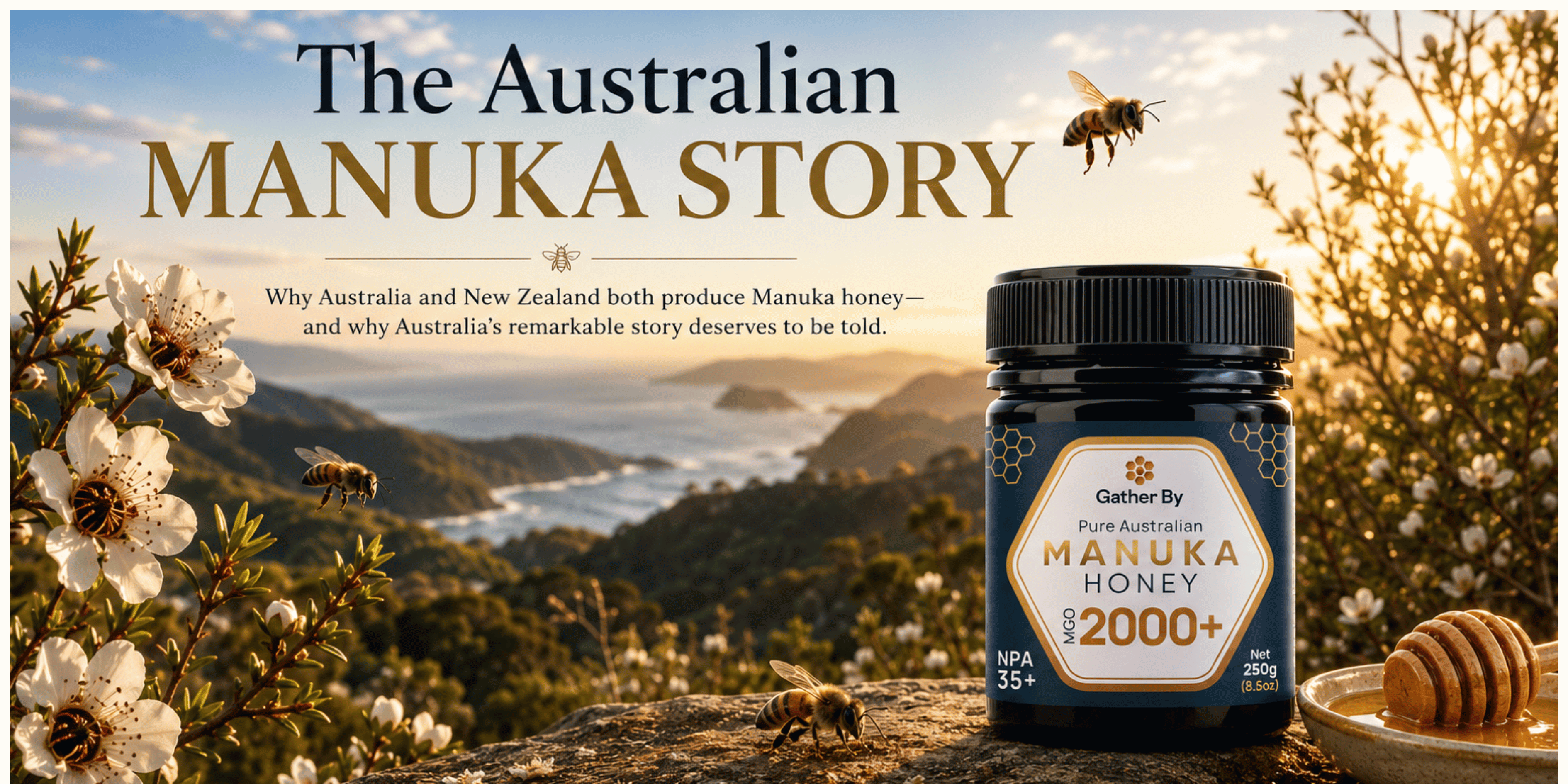
The Australian Manuka Story
Why Australia and New Zealand both produce Manuka honey—and why Australia's remarkable story deserves to be told.
There are very few natural foods with a story as remarkable as Manuka honey.
This is Australia's story.
Before You Dive In
Whether you're discovering Manuka honey for the first time or have enjoyed it for years, this guide will take you behind the label to explore one of Australia's most remarkable natural products.
In this guide you'll discover:
🍯 Why Australia and New Zealand both produce authentic Manuka honey—and why both deserve recognition.
🌿 How Australia's ancient landscapes and extraordinary biodiversity have created a Manuka story unlike anywhere else on Earth.
🔬 Why independent science, laboratory testing and authentication are essential to understanding genuine Australian Manuka honey.
🐝 How nature transforms nectar into one of the world's most fascinating natural foods.
🇦🇺 Why Gather By proudly places transparency, traceability and independent verification at the heart of every jar.
Estimated reading time: 14–16 minute
Introduction
If you've ever stood in front of a shelf of Manuka honey, you've probably asked yourself a simple question.
What's the difference between Australian and New Zealand Manuka honey?
It's a fair question.
For many years, New Zealand introduced much of the world to Manuka honey and deserves enormous credit for pioneering research, building international awareness and establishing one of the world's most recognised premium honey categories.
But that's only part of the story.
Across Australia, from the subtropical rainforests of northern New South Wales and Queensland to the temperate landscapes of Victoria, South Australia, Tasmania and Western Australia, native Leptospermum species have flourished for millions of years.
These remarkable plants have quietly supported healthy ecosystems, nourished honey bees and produced exceptional Manuka honey long before the modern world began to understand their significance.
Today, Australia is writing a remarkable chapter of its own.
Not by trying to imitate New Zealand.
But by discovering and celebrating what makes Australian Manuka uniquely Australian.
That journey has been built on curiosity rather than competition.
On collaboration between growers, beekeepers, universities, independent laboratories and organisations such as the Australian Manuka Honey Association (AMHA), all working together to better understand one of nature's most extraordinary gifts.
At Gather By, we've been privileged to contribute to that journey for more than a decade.
Along the way, we've learnt something important.
The more we understand about Australian Manuka honey...
...the more remarkable its story becomes.
This article isn't about deciding whether one country's Manuka honey is "better" than another's.
It's about understanding why Australia and New Zealand each have their own authentic Manuka story—and why Australia's story deserves to stand proudly alongside the very best in the world.
We hope you enjoy the journey.
What Exactly Is Manuka Honey?
At first glance, Manuka honey looks much like any other honey.
Yet behind every spoonful lies one of nature's most remarkable partnerships.
It begins with a flowering shrub belonging to the Leptospermum genus—a group of native plants found naturally throughout Australia and New Zealand.
When honey bees visit these flowers, they collect nectar rich in naturally occurring compounds unique to these remarkable plants.
Back in the hive, the bees transform that nectar into honey through a series of extraordinary natural processes that scientists are still working to fully understand.
Over time, another remarkable transformation occurs.
Within genuine Manuka honey, a naturally occurring compound known as dihydroxyacetone (DHA) slowly converts into methylglyoxal (MGO)—the compound now recognised as one of the key markers associated with Manuka honey.
Unlike many foods that gradually lose their desirable qualities with age, authentic Manuka honey can continue developing as this natural conversion takes place.
It is one of the reasons Manuka honey has fascinated researchers for decades.
But here's where one of the biggest misconceptions begins.
Many people assume that all Manuka honey is exactly the same.
It isn't.
Just as wines reflect the vineyards where grapes are grown, Manuka honey reflects the landscapes, climate, soils, flowering seasons and native plant species from which it comes.
Every harvest is a little different.
Every flowering season tells its own story.
Every region contributes something unique.
That natural variation isn't a flaw.
It's one of the defining characteristics of authentic Manuka honey.
Nature doesn't work from a blueprint.
It works through diversity.
And that diversity is one of its greatest strengths.
Understanding this simple idea helps explain why Australian and New Zealand Manuka honey can both be authentic while each developing their own distinctive characteristics.
The story isn't about one country being right and the other being wrong.
It's about recognising that nature expresses itself differently in different places.
That understanding has shaped decades of scientific research on both sides of the Tasman.
And it has led Australia to ask an important question.
If Australia's landscapes are different...
If Australia's native plant species are different...
What might Australian Manuka honey reveal that the world is only just beginning to understand?
The answer begins with Australia's remarkable biodiversity.
An Ancient Landscape That Wrote Its Own Story
Long before people spoke of Manuka honey...
Long before there were laboratories, quality standards or international markets...
Nature was already writing Australia's story.
Australia is one of the oldest continuously exposed landmasses on Earth.
Over millions of years, shifting climates, changing coastlines and remarkable geological stability created landscapes unlike anywhere else in the world.
Those ancient landscapes became home to an extraordinary diversity of native plants, many of which evolved nowhere else on Earth.
Among them was a remarkable group of flowering shrubs and trees belonging to the Leptospermum genus.
Today, Australia is recognised as home to more than 80 native Leptospermum species, compared with New Zealand's predominantly single commercially significant species, Leptospermum scoparium.
This isn't simply an interesting botanical fact.
It helps explain why Australia's Manuka story is so distinctive.
Each native species has adapted over countless generations to its own environment.
Some thrive along windswept coastlines.
Others flourish in subtropical rainforests, mountain ranges, dry forests or alpine regions.
Each flowers according to its own rhythm.
Each produces nectar shaped by its own genetics and the environment in which it grows.
That remarkable diversity creates an equally remarkable natural mosaic.
No two Australian Manuka landscapes are exactly alike.
No two flowering seasons are identical.
And no two harvests tell precisely the same story.
Rather than producing uniformity, nature produces diversity.
That diversity is one of Australia's greatest strengths.
It is also one of the reasons Australian researchers chose not to simply assume that findings from one country would automatically apply to another.
Instead, they asked a simple but profound question:
What makes Australia's own native Leptospermum species unique?
The answer could only come from Australian research, Australian landscapes and Australian observation.
It could not simply be borrowed.
That decision marked the beginning of a remarkable scientific journey—one that continues to shape Australia's understanding of Manuka honey today.
Yet biodiversity alone doesn't explain everything.
Scientists soon discovered that another remarkable story was unfolding inside the flowers themselves.
Nature's Hidden Chemistry
What makes Manuka honey so different from other honeys?
The answer isn't found in the hive.
It begins much earlier.
Inside the flower itself.
When a honey bee visits a flowering Leptospermum plant, it collects nectar rich in naturally occurring compounds that have evolved over millions of years.
One of those compounds is dihydroxyacetone, more commonly known as DHA.
Although few consumers have heard of it, DHA plays an extraordinary role in the Manuka story.
Unlike most floral nectars, which are simply transformed into honey by the bees, the nectar of bioactive Leptospermum species continues changing long after it has been collected.
As the honey naturally matures, DHA gradually converts into methylglyoxal (MGO).
This remarkable transformation is unique to Manuka honey and is one of the defining reasons it has attracted worldwide scientific interest.
Nature, quite literally, continues working after the bees have finished theirs.
It is a reminder that authentic Manuka honey isn't manufactured.
It matures.
More Than One Compound
It would be easy to think that MGO tells the whole story.
It doesn't.
In reality, Manuka honey is one of nature's most chemically complex foods.
Alongside DHA and MGO are many other naturally occurring compounds, including leptosperin, phenolic compounds, aromatic compounds, organic acids, enzymes and naturally occurring sugars.
Each contributes to the honey's unique chemical fingerprint.
Scientists continue exploring how these compounds interact and what role they may play in defining the unique characteristics of Manuka honey.
The more we learn, the more we appreciate that no single number can fully describe what nature has created.
But it is only one chapter in a much larger story.
Every Landscape Leaves Its Signature
Just as no two vineyards produce identical wines, no two Manuka landscapes produce identical honey.
Climate.
Rainfall.
Soil.
Altitude.
Flowering intensity.
Plant genetics.
Bee health.
Even the weather during flowering can influence the nectar collected by honey bees.
Every harvest carries the signature of the season that produced it.
This natural variation isn't something to overcome.
It's something to celebrate.
It reminds us that authentic Manuka honey is a living natural product, shaped by countless interactions between plants, pollinators and the environment.
Nature doesn't work to exact formulas.
It works through extraordinary diversity.
Science Helps Us Understand Nature
For decades, researchers have worked to better understand this remarkable chemistry.
Every nectar sample analysed.
Every laboratory result.
Every flowering season observed.
Adds another piece to the puzzle.
Science doesn't replace nature.
It helps us understand it.
And with every new discovery, our appreciation for Australian Manuka honey continues to grow.
That understanding naturally leads to another question.
If MGO is only one part of the story...
Why has it become the number displayed so prominently on every jar?
The answer lies in one simple word.
Confidence.
Understanding MGO – Nature's Signature
If you've ever purchased Manuka honey, you've probably noticed numbers such as MGO 100+, MGO 300+, MGO 600+ or even MGO 1200+ displayed prominently on the label.
But what do those numbers actually mean?
MGO stands for methylglyoxal, a naturally occurring compound that develops in genuine Manuka honey as it matures.
The number shown on the label represents the minimum amount of methylglyoxal, measured in milligrams per kilogram (mg/kg), that has been independently verified in the honey at the time it is tested.
For consumers, MGO provides a simple and internationally recognised way to compare the potency of different Manuka honeys.
A jar labelled MGO 300+ contains at least 300 mg of methylglyoxal per kilogram of honey.
An MGO 600+ honey contains at least twice that amount.
The higher the number, the greater the concentration of naturally occurring methylglyoxal.
This simple system has helped consumers around the world better understand Manuka honey and make informed choices based on their individual needs and preferences.
Why the "+" Matters
One small symbol on the label is often overlooked.
The plus sign (+).
Yet it carries an important meaning.
When a jar is labelled MGO 300+, it doesn't mean the honey contains exactly 300 mg/kg.
It means it contains at least that amount.
In many cases, the actual laboratory result will be comfortably above the stated minimum.
At Gather By, we intentionally label our honey conservatively.
Rather than chasing the highest possible number for marketing purposes, we want consumers to have confidence that every jar will meet—or exceed—the promise made on the label throughout its shelf life.
It's a simple philosophy.
Under-promise.
Over-deliver.
Because trust is built through consistency.
One Measure Among Many
Although MGO has become the most recognised measure of Manuka honey, it isn't the only one.
Scientists also analyse naturally occurring compounds such as DHA, leptosperin and other botanical markers that help confirm authenticity and better understand each honey's unique characteristics.
Each contributes another piece to the overall picture.
Think of MGO as an important chapter in the story—not the entire book.
Just as a single blood test can't describe every aspect of human health, one measurement alone can't fully define one of nature's most complex foods.
That's why responsible producers rely on comprehensive laboratory testing rather than a single result.
The goal isn't simply to achieve a high number.
It's to understand the honey as completely as possible.
Confidence Through Independent Testing
Every batch of authentic Manuka honey should be independently tested before it reaches consumers.
These laboratory analyses verify the honey's chemical profile, confirm the MGO level and help ensure the product meets the standards claimed on the label.
Independent testing gives confidence to everyone involved.
Beekeepers know the value of their harvest.
Packers know exactly what they're producing.
Retailers know what they're selling.
And consumers know they can trust what's inside the jar.
For Gather By, laboratory testing isn't just part of quality assurance.
It's part of our commitment to transparency.
Because genuine confidence comes from evidence, not marketing.
Looking Beyond a Single Number
As valuable as MGO is, scientists have long recognised that understanding Manuka honey requires looking beyond any single measurement.
Questions naturally arise.
How can we be certain the honey really comes from Leptospermum nectar?
How do we distinguish genuine Manuka honey from other floral honeys?
And how can consumers have confidence that the honey they're buying is authentically Australian Manuka?
Answering those questions has led Australian researchers and the Australian Manuka Honey Association to develop one of the world's most rigorous approaches to authentication.
Authenticity Matters
As Manuka honey has grown in popularity around the world, so too has an important question.
How can consumers be confident they're buying genuine Manuka honey?
It's a reasonable question.
Premium natural foods inevitably attract greater scrutiny. Consumers want confidence that what they're buying is authentic, independently verified and true to the claims made on the label.
For Australian Manuka honey, that confidence is built on science.
Looking Beyond MGO
While MGO is an important measure of Manuka honey, it does not, on its own, confirm where the honey came from.
Many naturally occurring compounds contribute to the unique chemical fingerprint of genuine Manuka honey.
Scientists therefore look beyond a single measurement, analysing a combination of naturally occurring markers that together provide a far more complete picture of the honey's botanical origin and authenticity.
Just as a fingerprint is identified by many points of comparison rather than one characteristic, authentic Manuka honey is confirmed by examining multiple naturally occurring attributes.
This approach provides greater confidence for producers, retailers and consumers alike.
Australia's Scientific Journey
Recognising Australia's extraordinary diversity of native Leptospermum species, Australian researchers understood that authentication needed to reflect Australia's own flora rather than simply adopting overseas standards.
Over many years, scientists collected nectar samples, analysed honey from across the country and studied the chemical characteristics of Australia's native species.
That work involved universities, independent laboratories, beekeepers and honey producers working together to build a scientific understanding of Australian Manuka honey.
Rather than asking whether Australian Manuka was the same as New Zealand's, the research asked a different question.
What defines authentic Australian Manuka honey?
That distinction is important.
Australia wasn't trying to replicate another country's science.
It was developing science appropriate for its own unique landscapes and native plant species.
The Australian Manuka Honey Association
To help protect consumers and support confidence in Australian Manuka honey, the Australian Manuka Honey Association (AMHA) has played a leading role in bringing industry and science together.
Working alongside researchers and independent laboratories, the AMHA has supported the development of robust authentication methods based on Australia's own native Leptospermum species.
These standards continue to evolve as scientific knowledge advances.
That's an important point.
Science is not static.
Every flowering season, every laboratory analysis and every research project adds to our understanding.
Strong standards are designed to grow stronger as new knowledge emerges.
Confidence Through Transparency
For consumers, authentication isn't about memorising scientific terminology.
It's about trust.
Knowing that the honey has been independently tested.
Knowing that it meets recognised standards.
Knowing that what's written on the label reflects what's inside the jar.
At Gather By, we believe transparency should never be optional.
It's why every batch is independently tested.
It's why we openly share laboratory results.
And it's why we welcome scientific scrutiny.
Because confidence isn't created through clever marketing.
It's earned through evidence.
Science Continues to Evolve
One of the most exciting aspects of Australian Manuka honey is that its story is still unfolding.
Researchers continue exploring Australia's native Leptospermum species.
New insights continue to emerge.
Every study deepens our understanding of how Australia's extraordinary biodiversity influences the chemistry of Manuka honey.
Far from having all the answers, Australian science remains driven by curiosity.
And that's exactly how good science should be.
Looking Ahead
Understanding authenticity helps us know what genuine Manuka honey is.
The next question is equally fascinating.
How did Australia build the scientific knowledge that underpins everything we've explored so far?
The answer lies in more than a decade of research, collaboration and discovery.
To authenticate Australian Manuka honey, laboratories assess multiple naturally occurring markers rather than relying on a single test. This multi-factor approach reflects the complexity of nature and provides greater confidence that the honey is genuinely derived from Australian Leptospermum nectar.
A Decade of Discovery
Scientific understanding doesn't happen overnight.
It is built through thousands of observations, careful experimentation and the willingness to ask questions that haven't yet been answered.
Australia's Manuka story is no different.
Over the past decade, Australian researchers, universities, beekeepers, growers and honey producers have worked together to better understand the remarkable diversity of Australia's native Leptospermum species and the honey they produce.
What began as curiosity has become one of the most comprehensive bodies of research ever undertaken into Australian Manuka honey.
Asking Different Questions
Australia's research journey began with a simple observation.
If Australia's landscapes are different...
If Australia's native Leptospermum species are different...
Then Australia's science needed to answer different questions.
Rather than assuming every species behaved the same, researchers set out to understand each one on its own merits.
How much DHA does its nectar naturally contain?
When does it flower?
How consistent is its nectar from season to season?
Which species produce commercially significant levels of bioactive honey?
How do climate, rainfall and geography influence nectar chemistry?
Every answer led to another question.
And with each discovery, Australia's understanding of Manuka honey became richer.
Research in the Field
Unlike laboratory science alone, much of Australia's Manuka research began in the landscape itself.
Researchers travelled across forests, coastal heathlands, mountain ranges and subtropical regions, collecting nectar and honey samples from native Leptospermum species growing in their natural environments.
These samples were analysed, compared and carefully documented over many flowering seasons.
Patterns began to emerge.
Some species consistently produced high levels of DHA.
Others produced little or none.
Some regions delivered exceptional results year after year, while others varied depending on seasonal conditions.
Nature wasn't random.
It had patterns waiting to be understood.
Collaboration Makes Better Science
One of the strengths of Australia's research has been its collaborative nature.
Universities.
Independent laboratories.
Commercial beekeepers.
Honey producers.
Landholders.
Industry organisations.
Each brought a different perspective.
Together, they built knowledge that no single organisation could have achieved alone.
Science advances most effectively when ideas are shared, tested and challenged.
That collaborative spirit continues today.
Our Contribution
At Gather By, we've been privileged to contribute to this journey from the beginning.
Over more than a decade, we've worked alongside researchers and industry partners to better understand Australia's native Leptospermum species.
That has included collecting nectar samples, supporting field research, analysing honey from different regions and helping identify native species with exceptional bioactive potential.
One of the most exciting outcomes has been the identification of Australian species capable of producing naturally high levels of DHA and, ultimately, exceptional MGO.
The work is ongoing.
Every flowering season provides another opportunity to learn.
Science Never Stands Still
Perhaps the greatest lesson from the past decade is that science is never truly finished.
Each season brings new data.
Each harvest provides new insights.
Each research project deepens our understanding of Australia's remarkable biodiversity.
Rather than seeking a final answer, researchers continue asking better questions.
That's what makes science exciting.
And it's one of the reasons Australian Manuka honey continues to attract international attention.
Not because the story has been completed...
But because there is still so much more to discover.
Looking Forward
The research has helped us understand where Australian Manuka honey comes from.
It has explained why Australia's native species are so remarkable.
It has strengthened confidence in authenticity.
But perhaps the most exciting question is still ahead.
What does the future of Australian Manuka look like?
That future begins with the landscapes that produce it.
Australian Manuka: A Story Still Being Written
Perhaps the most exciting thing about Australian Manuka honey is this.
Its story is only just beginning.
Unlike many agricultural industries with centuries of established practice, Australian Manuka continues to evolve with every flowering season.
Every new planting.
Every research project.
Every independent laboratory result.
Every observation made by a beekeeper standing quietly beside a flowering Leptospermum.
Each adds another piece to a story that is still unfolding.
That is what makes Australian Manuka so exciting.
Not because we believe we have all the answers.
But because there is still so much to discover.
A Living Industry
Australian Manuka is more than a remarkable natural product.
It is the result of thousands of people working together to better understand one of Australia's most extraordinary native resources.
Across the country, growers are establishing carefully planned plantings of native Leptospermum species.
Beekeepers continue learning how different landscapes and flowering seasons influence nectar flows.
Researchers expand our understanding of nectar chemistry, plant genetics and authentication.
Every season brings fresh insights.
Every harvest deepens our understanding.
Together, these efforts are helping build an industry founded not only on commercial success, but on scientific understanding, environmental stewardship and a genuine respect for nature.
Growing More Than Honey
One of the most rewarding aspects of Australian Manuka is that its benefits reach far beyond the honey itself.
Every new planting has the potential to restore something larger.
Healthy Leptospermum forests provide valuable forage for honey bees and native pollinators.
They help stabilise soils.
Support biodiversity.
Create habitat for wildlife.
Improve degraded landscapes.
And provide new opportunities for Australian farming communities.
For many of us, the goal has never been simply to produce more honey.
It has been to leave the landscape healthier than we found it.
Because when nature thrives, everything connected to it has the opportunity to thrive as well.
A Partnership Between Nature and People
The Australian Manuka story has never belonged to one company.
Or one beekeeper.
Or one researcher.
It belongs to thousands of Australians who have quietly contributed their knowledge, experience and passion over many years.
Researchers asking difficult questions.
Beekeepers observing flowering seasons.
Growers planting for future generations.
Universities expanding scientific understanding.
Industry organisations building confidence through independent standards.
Consumers choosing products that support responsible Australian production.
Each contribution may seem small on its own.
Together, they are shaping one of Australia's most exciting natural industries.
Gather By's Journey
At Gather By, we've been fortunate to play a small part in that story.
For more than a decade, we've worked alongside growers, beekeepers and research partners, learning from Australia's native Leptospermum species through observation, planting, nectar testing and commercial honey production.
Those experiences have continually reinforced one simple lesson.
Nature is always the greatest teacher.
That belief inspired the development of our Medicinal Honey Forest™ initiative.
By working with landholders, growers and beekeepers to establish carefully selected native Leptospermum plantings, we're helping create healthier landscapes that support biodiversity, healthy pollinator populations and future generations of Australian Manuka production.
The more we learn, the more we realise that when nature is cared for, it gives back in remarkable ways.
Looking Beyond the Jar
When most people pick up a jar of Manuka honey, they see a premium natural food.
What they may not see is everything that made it possible.
Millions of years of evolution.
Ancient Australian landscapes.
Extraordinary botanical diversity.
Healthy honey bees.
Dedicated growers.
Scientific research.
Independent authentication.
Responsible harvesting.
Careful packing.
Complete traceability.
Every jar represents an extraordinary partnership between nature and people.
Perhaps that's why Australian Manuka feels different.
It isn't simply harvested.
It's understood.
The Future Is Bright
Australian Manuka is now being enjoyed in homes around the world.
As more people discover Australia's remarkable native flora, independent scientific research and commitment to transparency, recognition continues to grow.
Not because Australia is trying to become someone else.
But because it has embraced what makes it uniquely Australian.
And perhaps that is the most exciting part of all.
The story is still being written.
Every flowering season.
Every discovery.
Every generation that chooses to protect Australia's remarkable landscapes while continuing to learn from them.
Because the greatest chapters of Australian Manuka may still lie ahead.
Why We Tell This Story
When we founded Gather By, our ambition wasn't simply to produce exceptional Australian Manuka honey.
It was to better understand it.
That belief has guided everything we've done.
For more than a decade, we've worked alongside growers, beekeepers, researchers and industry partners to learn from Australia's remarkable native Leptospermum species and the landscapes in which they thrive.
The more we learnt, the more we realised that Australian Manuka honey is far more than a premium natural food.
It is the product of millions of years of evolution.
Ancient landscapes.
Healthy pollinators.
Dedicated growers.
Scientific curiosity.
Independent verification.
And countless people working together to better understand one of Australia's most remarkable natural gifts.
That's why we've chosen to tell this story.
Not because it carries our name.
But because we believe consumers deserve to understand what they're buying.
Where it comes from.
Why Australia's native flora is so remarkable.
How independent science builds confidence.
And why transparency matters just as much as quality.
More Than a Label
Every jar of Gather By Manuka honey carries information that tells part of its story.
An independently tested MGO rating.
The Australian Manuka Honey Association's Mark of Authenticity.
A unique QR authentication code.
These aren't simply features of our packaging.
They represent our commitment to transparency.
Because confidence should never rely on marketing claims alone.
It should be supported by evidence, independent verification and a willingness to share what we know.
What We've Learnt
After more than ten years of learning from Australian Manuka, one lesson stands above all others.
Nature is remarkably generous to those who take the time to understand it.
Every flowering season teaches something new.
Every harvest reminds us that no two years are ever the same.
Every research project deepens our appreciation for Australia's extraordinary biodiversity.
The journey hasn't made us feel that we know everything.
Quite the opposite.
It has shown us just how much there is still to discover.
Looking Forward
Australian Manuka honey has earned its place among the world's great natural foods.
Not through marketing.
But through remarkable native flora.
Independent scientific research.
Responsible stewardship.
And a growing commitment to transparency.
At Gather By, we feel privileged to contribute to that journey.
We'll continue learning.
We'll continue supporting Australian research.
We'll continue investing in healthier landscapes.
And we'll continue sharing what we discover with the people who place their trust in every jar we produce.
Because understanding builds confidence.
And confidence begins with knowing the story behind the honey.
Frequently Asked Questions
Is Australian Manuka honey genuine?
Yes. Australian Manuka honey is produced from the nectar of native Australian Leptospermum species. Australia is home to more than 80 recognised species, many capable of producing naturally bioactive Manuka honey.
Authentic Australian Manuka is independently tested and authenticated using scientific methods developed specifically for Australia's unique flora.
Is Australian Manuka better than New Zealand Manuka?
Rather than asking which is "better", it's more accurate to recognise that Australia and New Zealand each produce authentic Manuka honey.
New Zealand's industry is centred primarily on Leptospermum scoparium, while Australia's industry draws upon a remarkable diversity of native Leptospermum species.
Both countries have invested heavily in research and rigorous quality standards.
The best choice is authentic Manuka honey from a producer you trust.
Why is New Zealand often written as "Mānuka" while Australia uses "Manuka"?
The macron (ā) is part of the Māori spelling used in New Zealand.
Australia has traditionally used the English spelling "Manuka" when referring to its native Leptospermum species and the honey they produce.
Both spellings are correct within their respective contexts.
What does the MGO number mean?
MGO measures the concentration of methylglyoxal—the naturally occurring compound associated with the unique non-peroxide antibacterial activity of Manuka honey.
The higher the MGO number, the greater the measured concentration at the time of independent laboratory testing.
Why is there a "+" after the MGO number?
The "+" means the honey contains at least the stated MGO level.
At Gather By, every batch is independently tested before packing to ensure it comfortably exceeds the labelled minimum.
Is MGO the only thing that matters?
No.
MGO is an important and internationally recognised measure of potency, but Manuka honey is naturally complex.
Its unique properties are influenced by many naturally occurring compounds working together, along with the landscape, flowering season and the health of the bees that produced it.
Why does Australia have its own authentication system?
Because Australia's native Leptospermum species are different.
Authentication should reflect the plants being tested.
Australia's scientific community has developed authentication methods specifically for Australian Manuka honey, providing consumers with confidence in its authenticity and origin.
What is Australia's Factor Four Authentication?
Australia's authentication framework includes:
-
Australian geographic origin
-
DHA
-
MGO
-
3-PLA
-
2-MBA
Together, these markers provide a scientific profile consistent with authentic Australian Manuka honey.
How can I identify genuine Australian Manuka honey?
Look for:
-
Australian origin
-
Clearly displayed MGO rating
-
Independent laboratory testing
-
AMHA Mark of Authenticity (where applicable)
-
Product traceability
-
A producer committed to transparency
Confidence comes from multiple layers of verification—not a single claim.
Why does Gather By display the MGO rating on every jar?
Because we believe consumers deserve to know exactly what they're buying.
Displaying the independently tested MGO rating provides a simple, transparent and internationally recognised measure of potency.
Why does Gather By display the AMHA Mark of Authenticity?
The AMHA Mark represents the Australian industry's commitment to science, authentication and consumer confidence.
We're proud to display it because it demonstrates our support for an industry built on transparency and independently developed scientific standards.
Why does every Gather By jar include a QR code?
Every jar carries its own unique authentication QR code.
It allows our quality assurance system to identify individual products and reflects our commitment to traceability and transparency.
Can the MGO level change over time?
Yes.
As Manuka honey matures, naturally occurring DHA may continue converting into MGO under appropriate storage conditions.
This natural maturation is one of the characteristics that makes authentic Manuka honey unique.
Why doesn't every harvest produce exactly the same honey?
Because nature doesn't produce identical seasons.
Rainfall, temperature, soil conditions, flowering intensity and bee health all influence the nectar collected by honey bees.
Like fine wine, every harvest reflects the season that produced it.
Why does Gather By talk so much about biodiversity?
Because exceptional honey begins with exceptional landscapes.
Healthy Leptospermum forests support healthy pollinators, healthy ecosystems and, ultimately, premium Australian Manuka honey.
Protecting biodiversity is fundamental to producing remarkable honey.
Final Thoughts
Perhaps the greatest lesson Australian Manuka honey teaches us is that nature rarely tells simple stories.
It doesn't recognise international borders.
It doesn't work to neat categories.
And it certainly doesn't create something as remarkable as Manuka honey through a single ingredient, a single plant or a single measurement.
Instead, it reminds us that extraordinary things happen when nature is given the time and opportunity to flourish.
Australia and New Zealand have each contributed something valuable to the story of Manuka honey.
New Zealand introduced millions of people around the world to one of nature's most remarkable gifts.
Australia is continuing that story through its own extraordinary landscapes, native Leptospermum species, scientific research and growing understanding of one of the world's most fascinating natural foods.
At Gather By, we feel privileged to be part of that journey.
Our role has never been simply to produce exceptional Australian Manuka honey.
It has been to keep learning.
To work alongside growers, beekeepers and researchers.
To support healthier landscapes.
And to share what we discover with the people who place their trust in every jar we produce.
Because we believe understanding builds confidence.
And confidence begins with knowing the story behind the honey.
If this article has helped you see Australian Manuka a little differently, then it has achieved exactly what we hoped.
Not because we've convinced you that one country's Manuka is better than another.
But because we've shown that Australian Manuka deserves to be appreciated on its own remarkable merits.
Nature wrote the first chapter.
We're simply honoured to help tell the next.
A Personal Thank You
If you've taken the time to read this article, thank you.
Whether you're discovering Australian Manuka for the first time or have enjoyed it for many years, we hope you now have a deeper appreciation for the remarkable landscapes, native flora, healthy pollinators, growers, beekeepers and researchers that make every jar possible.
The next time you enjoy a spoonful of Australian Manuka honey, perhaps you'll see more than a premium natural food.
Perhaps you'll see one of Australia's most remarkable gifts from nature.
Thank you for taking the journey with us.
Matt Blomfield
Founder | Gather By

Leave a comment
This site is protected by hCaptcha and the hCaptcha Privacy Policy and Terms of Service apply.